
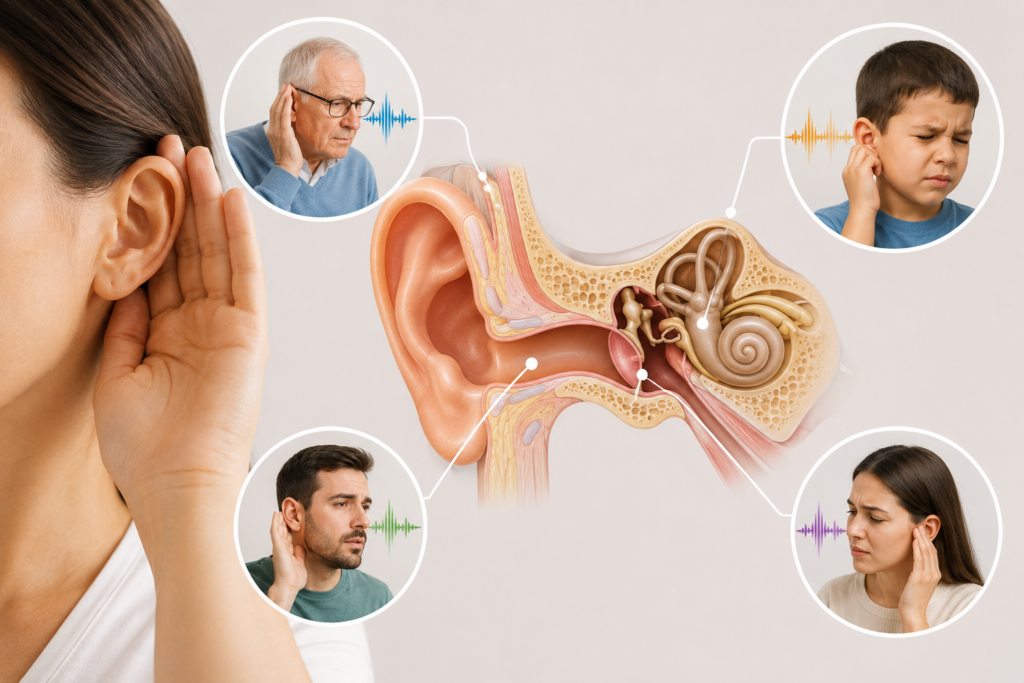
Hearing loss is classified into four main types: sensorineural, conductive, mixed hearing loss, and Auditory Neuropathy Spectrum Disorder (ANSD). These types are identified based on which part of the hearing system is affected, which helps an audiologist choose the most effective treatment and hearing support options. Identifying specific hearing loss symptoms early, such as struggling to follow conversations in noisy rooms or feeling that voices are muffled, is critical for choosing the right treatment pathway.best hearing test in Delhi
Regular clinical evaluations are essential to prevent secondary challenges like social isolation, mental exhaustion, and hearing fatigue. By mapping your specific condition, specialists can target the precise issue at hand. This comprehensive guide explores the structural classifications, underlying causes, and modern clinical diagnostic pathways used to restore clear, effortless communication.
Hearing loss is classified based on the part of the auditory system affected and the way sound signals are disrupted before reaching the brain.
Audiologists generally classify hearing loss into four primary categories:
Classification | Affected Area |
Conductive Hearing Loss | Outer or middle ear |
Sensorineural Hearing Loss | Inner ear (cochlea) or auditory nerve |
Mixed Hearing Loss | A combination of conductive and sensorineural loss |
Auditory Neuropathy Spectrum Disorder (ANSD) | Sound transmission between the inner ear and the brain |
Hearing loss may also be classified according to how much hearing ability has been reduced.
Severity Level | Hearing Threshold (dB) | Practical Real-World Impact |
Mild | 26–40 dB | Soft sounds, like whispers or rustling leaves, are tough to catch. Normal speech is clear, but background noise presents challenges. |
Moderate | 41–55 dB | Understanding normal conversation becomes difficult, especially in public spaces. You may find yourself frequently asking people to repeat themselves. |
Moderately Severe | 56–70 dB | Speech must be significantly louder than normal. Group conversations are highly stressful to follow without assistance. |
Severe | 71–90 dB | Conversational speech is completely inaudible. You may only recognize exceptionally loud shouts, car horns, or heavy machinery. |
Profound | Above 90 dB | Extremely loud sounds are felt as physical vibrations rather than heard. Communication relies heavily on visual cues or sign language. |
The severity classification helps audiologists determine whether medical treatment, hearing aids, cochlear implants, or assistive listening devices may provide the greatest benefit.
Some individuals lose the ability to hear specific sound pitches rather than experiencing a uniform drop across all audio channels. Common directional patterns include:
Auditory conditions are classified by the specific location of the problem within the ear system: the outer, middle, or inner ear.
This is the most common variety of permanent hearing loss. It occurs when there is damage to the delicate hair cells inside the inner ear (cochlea) or along the nerve pathways that send sound information to the brain.
This category happens when a mechanical block or physical issue prevents sound waves from moving properly through the outer or middle ear.
Mixed hearing loss occurs when an individual experiences a combination of sensorineural and conductive issues at the same time.
ANSD is a specific transmission issue where the inner ear detects sound normally, but the transfer of signals from the ear to the brain is uncoordinated.
Recognizing the early warning signs prevents minor hearing issues from causing long-term communication frustration. While symptoms can vary based on the specific category, typical warning signs include:
Symptom | Conductive | Sensorineural | Mixed |
Muffled hearing | ✓ | ✓ | ✓ |
Reduced volume | ✓ | ✓ | ✓ |
Difficulty understanding speech | Sometimes | Very common | Very common |
Tinnitus | Less common | Common | Common |
Ear fullness | Common | Rare | Possible |
Difficulty hearing in noise | Sometimes | Very common | Very common |
Pinpointing the exact type of hearing issue requires a series of quick, painless diagnostic tests. If you notice changes in your daily communication, seeking out the best hearing test in Delhi is the most reliable way to accurately map your ear health.
During a standard evaluation, an expert will guide you through:
Beyond these major structural types, hearing loss can display specific shapes across the sound frequency spectrum. A notable example is low-frequency hearing loss, which creates a unique listening pattern.
Modern treatment paths are highly customized and depend entirely on the physical location and cause of your specific hearing challenge.
Hearing Loss Type | Primary Location | Common Treatment Path |
Sensorineural | Inner Ear/Auditory Nerve | Digital hearing aids, cochlear implants |
Conductive | Outer or Middle Ear | Medical wax removal, infection treatment, or surgery |
Mixed | Inner & Outer/Middle Ear | Combined medical clearing and hearing aid use |
ANSD | Auditory Nerve Coordination | Auditory therapy, specialized assistive listening devices |
Ignoring permanent hearing symptoms goes beyond ear comfort; it directly affects long-term brain health. When sound signals reaching the brain are constantly weak or broken, the brain must exert massive extra listening effort to piece words together. This constant strain causes chronic mental exhaustion and listening fatigue.
Clinical research shows that when the sound-processing centers of the brain remain unstimulated for years, they can experience gradual changes. This lack of daily mental stimulation is a known risk factor for accelerated cognitive decline and memory issues. Additionally, the frustration of straining to hear often causes individuals to isolate themselves socially, which can trigger feelings of anxiety and depression.
The primary goal of classifying hearing loss is to identify the exact cause of a communication barrier so you can receive the correct treatment. Whether an individual needs straightforward medical care for a physical blockage or digital hearing aids to restore nerve clarity, taking early action protects both your hearing and your long-term brain health.
Scheduling a professional evaluation removes the guesswork and ensures that any medical care or digital technology perfectly fits your unique acoustic needs. Taking this step eliminates daily listening strain, keeps your mind sharp, and keeps you fully connected to your loved ones and community.
Not sure whether your symptoms are caused by earwax buildup, a middle ear condition, or permanent hearing loss? Book a professional hearing test in Delhi with Hearing Hope and receive a personalized treatment plan tailored to your hearing profile, lifestyle, and budget.

The editorial team at Hearing Hope intends to share expert-certified information on hearing loss, hearing tests, and hearing care solutions. We aim to ease your journey and provide you with reliable information and aid.
Get In Touch
Conductive hearing loss can often be completely reversed once the underlying mechanical issue is resolved.
While not all hearing loss can be prevented, several steps can help reduce risk:
Sensorineural hearing loss is the most common type of hearing loss. It usually occurs because of aging, long-term noise exposure, certain illnesses, or damage to the inner ear and auditory nerve.
Fluctuating hearing loss is an auditory condition where an individual's ability to perceive sound volume or clarity changes from day to day.
It is most commonly caused by shifting fluid pressures behind the eardrum or underlying chronic inner ear issues like Meniere’s disease.
Medical tracking is necessary to prevent temporary drops from turning into permanent structural nerve damage.
Conductive hearing loss occurs when sound cannot travel properly through the outer or middle ear. Sensorineural hearing loss occurs when the inner ear or auditory nerve is damaged. Conductive hearing loss can often be treated medically, while sensorineural hearing loss is usually managed with hearing aids or implants.
A standard, comprehensive hearing evaluation typically takes between 30 and 60 minutes to complete.
The entire diagnostic session is completely painless, non-invasive, and safe for individuals of all ages.
The test provides an immediate visual map of your auditory health, allowing for instant treatment discussions.
Not delaying a professional evaluation can allow the underlying auditory processing difficulties to worsen.
Hearing loss types are diagnosed through a combination of pure tone audiometry, speech discrimination tests, and tympanometry.
Yes. Mixed hearing loss occurs when a person has both conductive and sensorineural hearing loss at the same time. This means there is a problem in both the sound transmission pathway and the inner ear.
Common early signs include difficulty understanding conversations, asking people to repeat themselves frequently, increasing the television volume, hearing muffled speech, and struggling to hear in noisy environments.
Hearing aids are most commonly recommended for sensorineural hearing loss and some cases of mixed hearing loss. The type of device depends on the severity and cause of the hearing problem.
No. Conductive hearing loss is often temporary and may improve after medical treatment. Sensorineural hearing loss is usually permanent, but hearing aids and cochlear implants can significantly improve communication.
Auditory Neuropathy Spectrum Disorder (ANSD) is considered less common than conductive or sensorineural hearing loss. It affects how sound signals are transmitted from the inner ear to the brain.
Yes. Hearing loss can occur in one ear (unilateral hearing loss) or both ears (bilateral hearing loss). The cause and treatment depend on the underlying condition.
Hearing loss can occur at any age. While age-related hearing loss typically develops after age 60, noise exposure, infections, genetics, and medical conditions can cause hearing loss much earlier.
You should schedule a hearing evaluation if you frequently ask people to repeat themselves, struggle in noisy environments, experience ringing in the ears, or notice a sudden change in hearing.