Hearing loss affects millions of people worldwide, yet one of the most common questions patients ask after an assessment is: “What is my actual hearing loss percentage?”
Whether you are applying for a government disability certificate, seeking insurance benefits, planning treatment with hearing aids, or simply trying to read your audiogram, knowing how to calculate hearing loss percentage gives you essential clarity.
It is a common misconception that decibels translate directly into percentages; a 50 dB loss does not mean you have lost 50% of your hearing. Clinical evaluations use standardized formulas that weigh sound frequencies and compare how both ears work together.
In this guide, you will learn what hearing loss percentage means, how audiologists calculate it, how to calculate the Pure Tone Average (PTA), the difference between hearing loss and disability percentage, and how official assessments work in India.
Hearing loss percentage is a calculated number that shows how much your overall hearing ability has decreased compared to normal hearing.
Instead of looking at just one sound or pitch, audiologists measure your hearing across multiple frequencies during a diagnostic test. They then use standardized medical formulas to combine those results into a single percentage.
While a label like “mild hearing loss” describes your general hearing level, an exact percentage provides a precise metric used for:
Think of your hearing like a piano keyboard. Every key represents a different sound frequency. Some people may hear low-pitched sounds well but struggle with higher frequencies, while others experience the opposite.
Hearing loss percentage combines information from multiple frequencies to provide a broader picture of hearing function.
Note: Two people with the exact same percentage might experience daily conversations differently depending on speech clarity and background noise.
Calculating hearing loss percentage helps healthcare professionals:
Without an accurate percentage, treatment decisions may be incomplete or inconsistent.
Many people use these terms interchangeably, but they have different meanings. Hearing loss percentage describes how much hearing has been reduced, whereas hearing disability percentage determines how that hearing loss affects daily functioning according to official assessment standards.
Hearing Loss Percentage | Hearing Disability Percentage |
Measures the degree of hearing loss | Measures functional disability caused by hearing loss. |
Based on audiometric test results | Based on approved disability assessment guidelines. |
Used by audiologists for diagnosis | Used for disability certification and benefits. |
Focuses on hearing thresholds | Considers prescribed calculation methods and eligibility criteria. |
Another area of confusion is the difference between hearing impairment and hearing disability.
For example, two people with similar hearing thresholds may have different disability percentages depending on official assessment criteria and functional limitations.
Hearing loss does not automatically qualify as a disability. Government authorities and certified medical boards evaluate hearing according to established guidelines before determining eligibility for disability certificates and associated benefits. These assessments follow approved clinical methods rather than relying on self-calculated values or online estimates.
Before learning the calculation process, it’s important to understand how hearing works and how audiologists measure it. Accurate hearing percentage calculations begin with reliable hearing assessments, not mathematical formulas alone.
Hearing is a complex process involving several parts of the ear working together.
Damage anywhere along this pathway can result in hearing loss.
Audiologists classify hearing ability according to hearing thresholds measured in decibels (dB HL).
Hearing Level | Hearing Threshold |
Normal | -10 to 20 dB |
Mild | 21–40 dB |
Moderate | 41–55 dB |
Moderately Severe | 56–70 dB |
Severe | 71–90 dB |
Profound | Above 90 dB |
These categories help professionals determine the level of hearing loss, recommend treatment options, and monitor progression over time.
A hearing loss percentage cannot be calculated accurately without proper hearing evaluation. Depending on age, symptoms, and medical history, audiologists may perform several tests before applying any formula.
Pure-tone audiometry is the primary test used to calculate hearing loss percentage. During the test, you listen to tones of different frequencies through headphones and indicate when you hear each sound. The results establish your hearing threshold at key frequencies.
PTA forms the basis of most clinical calculations because it provides standardized and repeatable hearing measurements.
Speech audiometry evaluates how well you understand spoken words rather than simply detecting tones. Although it is not typically used directly in hearing percentage calculations, it offers valuable information about communication ability and hearing aid performance.
Tympanometry measures middle ear function by assessing eardrum movement. It helps identify conditions such as fluid behind the eardrum, ear infections, or Eustachian tube dysfunction that may contribute to hearing loss.
OAE testing evaluates the function of outer hair cells in the cochlea. It is particularly useful for newborn hearing screening and patients who cannot respond reliably during behavioral hearing tests.
ABR testing measures how sound signals travel through the auditory nerve and brainstem. This objective test is commonly used for infants, young children, and patients who cannot participate in conventional hearing assessments.
If you’re experiencing symptoms such as difficulty understanding conversations, ringing in the ears, or reduced hearing clarity, scheduling a professional hearing test service is the first step toward obtaining accurate results and appropriate treatment recommendations.
Five critical variables shape your final percentage calculation:
Standard clinical formulas focus on speech-range frequencies—specifically 500 Hz, 1000 Hz, 2000 Hz, and 4000 Hz (or 3000 Hz in some AAO-HNS protocols). Because human voice clarity relies heavily on these tones, losses in very low or ultra-high pitches have less weight in standard percentage calculations.
Your brain relies far more on your better-hearing ear for sound localization and conversation. Consequently, official formulas give the better ear 5 times the weight of the poorer ear when calculating total combined hearing loss.
Presbycusis (age-related hearing decline) naturally elevates thresholds over time, especially in high pitches. While legal formulas use raw decibel scores, clinical interpretations consider age-normative data during diagnostic evaluations.
The underlying anatomical source affects prognosis and treatment:
Understanding the specific types of hearing loss present helps determine whether medical intervention can lower the decibel threshold before finalizing long-term disability claims.
Now that you understand the fundamentals, let’s look at the actual calculation process used by audiologists.
The first step is to perform a professional pure-tone audiometry test. Hearing thresholds are recorded for each ear at important speech frequencies, commonly 500 Hz, 1000 Hz, 2000 Hz, and 4000 Hz.
Once the hearing thresholds have been recorded for each ear, the next step is to calculate the Pure Tone Average (PTA). PTA represents the average hearing threshold across the speech frequencies most important for everyday communication.
In most clinical assessments, the PTA is calculated using the hearing thresholds at 500 Hz, 1000 Hz, 2000 Hz, and 4000 Hz. These frequencies are chosen because they cover the range where most speech sounds occur.
Formula: TA = (dB at 500 Hz + dB at 1000 Hz + dB at 2000 Hz + dB at 4000Hz)/4
Example
Suppose the hearing thresholds in the right ear are:
Frequency | Hearing Threshold |
500 Hz | 30 dB |
1000 Hz | 40 dB |
2000 Hz | 50 dB |
4000 Hz | 60 dB |
The Pure Tone Average would be (30 + 40 + 50 + 60) ÷ 4 = 45 dB HL
This means the average hearing threshold for that ear is 45 dB, indicating moderate hearing loss. The PTA becomes the starting point for calculating the hearing loss percentage and, where applicable, the hearing disability percentage.
Monaural hearing loss refers to the percentage of impairment in one single ear.
Clinical standards establish that hearing levels up to 25 dB HL are considered normal human hearing. Therefore, the first 25 dB is subtracted as a base threshold fence. Every decibel above 25 dB represents a 1.5% hearing impairment.
Monaural Formula:
Monaural Loss Percentage = (PTA – 25) × 1.5
Note: If PTA is 25 dB or lower, monaural loss is 0%. The maximum possible monaural loss is capped at 100% (reached at 91.67 dB or higher).
Assume:
The right ear demonstrates moderate hearing loss, while the left ear remains within the normal to mild hearing range. These individual results are then combined when assessing hearing in both ears together.
Most people rely on both ears for communication, sound localization, and understanding speech in noisy environments. Because of this, disability assessments generally consider binaural hearing rather than evaluating each ear independently.
The better-hearing ear receives greater weighting because it contributes more significantly to daily communication.
Binaural Formula:
Binaural Loss Percentage = [(Better Ear Monoaural% × 5) Poorer Ear Monoaural%] / 6
Rather than simply averaging both ears, approved assessment methods apply a weighted calculation that reflects real-life listening ability.
Imagine one ear has severe hearing loss while the other hears almost normally. In everyday situations, the better ear compensates for much of the hearing deficit. Giving both ears equal importance would overestimate the person’s communication difficulties.
This is why official disability assessments place greater emphasis on the better ear.
Once the hearing thresholds have been analyzed, audiologists interpret the results according to recognized clinical and regulatory guidelines. The final hearing loss percentage helps determine the severity of hearing impairment and supports decisions related to treatment, rehabilitation, or further disability assessment.
Average Hearing Threshold | Clinical Interpretation |
0–20 dB | Normal Hearing |
21–40 dB | Mild Hearing Loss |
41–55 dB | Moderate Hearing Loss |
56–70 dB | Moderately Severe Hearing Loss |
71–90 dB | Severe Hearing Loss |
Above 90 dB | Profound Hearing Loss |
The hearing percentage alone does not determine whether someone qualifies for disability benefits. Functional ability, official assessment criteria, and applicable government guidelines also play important roles.
Many people search for the hearing disability percentage formula, expecting one universal equation. In reality, disability assessment formulas vary depending on the country, regulatory authority, and purpose of the evaluation.
Medical boards generally consider the following:
This standardized approach ensures consistency and fairness across disability evaluations.
Let’s look at a complete mathematical breakdown of the standard hearing disability percentage formula using real clinical numbers.
Binaural Loss = [(41.25 × 5) + 71.25] / 6 = (206.25 + 71.25) / 6 = 277.5 / 6 = 46.25%
Final Result: The patient has a 46.25% binaural hearing loss.
Even with the correct hearing thresholds, calculations can become inaccurate if:
For these reasons, hearing disability assessments should always be performed by certified professionals rather than relying solely on internet resources.
People searching for “hearing disability percentage calculation in India” are usually looking for disability certification, government benefits, or reservation eligibility.
In India, hearing disability assessment follows guidelines notified by the Department of Empowerment of Persons with Disabilities (DEPwD) under the Rights of Persons with Disabilities (RPwD) Act, 2016. Certified medical boards assess hearing impairment using prescribed audiological procedures and government-approved calculation methods.
The evaluation typically includes:
Only authorized government hospitals or designated medical boards can issue an official hearing disability certificate. Reports generated through online calculators or private self-assessments are generally not accepted for legal or government purposes.
Eligibility for disability benefits depends on the current government criteria, which may be updated periodically. The medical board considers both the severity of hearing impairment and the prescribed assessment framework before determining eligibility.
A hearing disability percentage calculator is an online tool that estimates hearing disability based on audiogram values entered by the user.
Most calculators request the following:
Online calculators cannot:
Treat them as educational tools, not as medical or legal assessments.
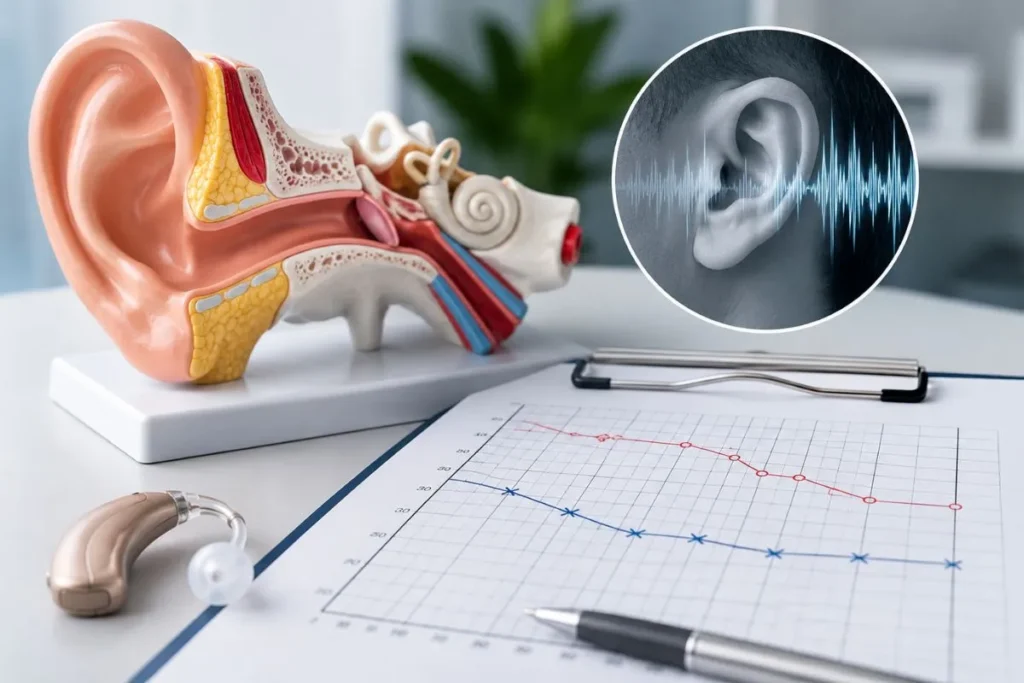
An audiogram is a visual chart that shows the softest sounds a person can hear at different sound frequencies (pitches). The horizontal axis displays frequencies (Hz), while the vertical axis shows hearing thresholds measured in decibels hearing level (dB HL). Separate symbols represent the hearing test results for the right and left ears.
An audiogram does not directly show your hearing loss percentage. Instead, it provides the hearing threshold data that audiologists use to calculate your Pure Tone Average (PTA) and determine your hearing loss percentage or hearing disability percentage using standardized clinical formulas.
Reading an audiogram accurately requires practice, so interpretation should always be confirmed by a qualified audiologist.
An audiogram is a visual graph that plots your hearing sensitivity:
Low Pitch ————————-> High Pitch
250 Hz 500 Hz 1000 Hz 2000 Hz 4000 Hz 8000 Hz
0 dB HL ——————————————————— (Normal Hearing)
20 dB HL ———————————————————
40 dB HL ——————————————————— (Mild Loss)
60 dB HL ——————————————————— (Moderate Loss)
80 dB HL ——————————————————— (Severe Loss)
Degree of Hearing Loss | Decibel Range (PTA) | Estimated Monaural Hearing Loss (%) | Typical Daily Impact |
Normal | 0–20 dB HL | 0% | Hears faint whispers and everyday conversations clearly. |
Mild | 21–40 dB HL | 0%–22.5% | May miss soft speech, whispers, and distant sounds, especially in noisy environments. |
Moderate | 41–55 dB HL | 24%–45% | Struggles to understand normal conversations without a hearing aid, particularly in groups. |
Moderately Severe | 56–70 dB HL | 46%–67.5% | Has significant difficulty hearing conversations and often requires hearing aids or amplification. |
Severe | 71–90 dB HL | 69%–97.5% | Cannot hear normal speech and relies heavily on hearing aids, lip-reading, or visual cues. |
Profound | 91+ dB HL | 100% | Hears only extremely loud sounds or vibrations and typically depends on visual communication or advanced hearing devices. |
Note: The estimated monaural hearing loss percentages are approximate values based on commonly used clinical calculation methods. An individual’s official hearing disability percentage is determined by applying standardized monaural or binaural hearing loss formulas to audiometric test results and may vary depending on the applicable medical or government guidelines.
Audiologists follow a systematic process rather than relying on a single formula.
A typical evaluation includes:
This comprehensive approach provides a more accurate picture of hearing health than any standalone calculator.
Children require specialized assessment techniques because they may not respond reliably during standard hearing tests. Audiologists may use behavioral audiometry, Otoacoustic Emissions (OAE), or Auditory Brainstem Response (ABR) testing depending on the child’s age and developmental stage.
Early diagnosis is essential because untreated hearing loss can affect speech, language development, learning, and social interaction.
Age-related hearing loss, known as presbycusis, commonly affects higher frequencies first. Older adults may struggle to understand speech, especially in noisy environments, even if they can hear sounds.
Comprehensive hearing evaluations help determine appropriate rehabilitation, including hearing aids, communication strategies, or other assistive technologies.
Avoid these common errors:
Avoiding these mistakes leads to more accurate interpretation and better treatment decisions.
Once your hearing loss percentage has been determined, your audiologist will discuss the most appropriate next steps.
Depending on the results, these may include the following:
Early intervention often improves communication outcomes and quality of life.
Understanding how to calculate hearing loss percentage is valuable for anyone seeking clarity about their hearing health, disability assessment, or treatment options. While the calculation itself starts with audiometric data and Pure Tone Average, interpreting the results requires clinical expertise and, for disability certification, adherence to official government guidelines.
Whether you’re reviewing your audiogram, applying for a disability certificate, or simply trying to understand your hearing better, remember that online estimates are only a starting point. A comprehensive assessment by a qualified audiologist provides the most accurate diagnosis, personalized recommendations, and access to the right treatment or rehabilitation services. Taking action early not only protects your hearing but also supports better communication and overall quality of life.
Don’t rely on estimates alone. Get an accurate hearing evaluation from expert audiologists and receive personalized guidance for the right treatment or hearing solution. Book your hearing test today and take the first step toward clearer hearing.

The editorial team at Hearing Hope intends to share expert-certified information on hearing loss, hearing tests, and hearing care solutions. We aim to ease your journey and provide you with reliable information and aid.
Get In Touch
Yes, you can estimate your hearing loss percentage if you have a professional audiogram and understand how to calculate the Pure Tone Average (PTA). However, a self-calculated estimate should only be used for educational purposes. It cannot replace a comprehensive hearing assessment performed by a qualified audiologist.
Professional evaluations consider additional factors that home calculations cannot measure, including speech recognition, bone conduction results, test reliability, medical history, and functional hearing ability. If you need an accurate diagnosis, treatment recommendation, or disability certification, always consult a licensed hearing care professional.
Online hearing disability percentage calculators can provide a rough estimate based on the hearing thresholds you enter. However, they cannot verify whether your audiogram is accurate or interpret clinical findings. Their results should never be used as a substitute for a professional hearing evaluation or an official disability assessment.
No. An audiogram is essential for calculating hearing loss percentage because it measures your hearing thresholds at specific frequencies. Without professional audiometric data, it is not possible to determine your hearing loss accurately.
To calculate hearing loss percentage, you typically need the following:
An audiologist may also use speech recognition scores and additional hearing tests depending on the purpose of the assessment.
Audiologists use standardized testing procedures, calibrated equipment, and approved clinical methods to determine hearing loss accurately. They also interpret your results in the context of your symptoms, medical history, and communication needs. This comprehensive assessment helps ensure the correct diagnosis, appropriate treatment, and reliable documentation for disability or insurance purposes.
No. A self-calculated hearing loss percentage or an online calculator result is not accepted for disability certification. In most countries, including India, hearing disability certificates must be issued by an authorized medical board or designated healthcare facility after a complete audiological evaluation.
Hearing loss is calculated from an audiogram by measuring hearing thresholds at key frequencies (500 Hz, 1000 Hz, 2000 Hz, and 4000 Hz). An audiologist calculates the Pure Tone Average (PTA) and applies approved clinical or government guidelines to estimate hearing loss or disability percentage.
No. Hearing loss varies across different frequencies. Audiologists assess multiple frequencies to calculate an overall hearing loss percentage rather than relying on a single hearing threshold.
Hearing loss percentage measures the degree of hearing reduction, while hearing impairment refers to the medical condition affecting hearing. They are related but are not always used interchangeably.
No. A 60 dB hearing threshold indicates the severity of hearing loss, while a 60% disability rating is determined using approved disability assessment guidelines. They are not equivalent.
A 30% hearing loss generally means mild to moderate hearing difficulty. You may struggle to hear soft speech or conversations in noisy environments but still communicate well in quieter settings.
A 20% disability rating reflects the functional impact of hearing impairment based on official assessment guidelines. It does not mean you have lost exactly 20% of your hearing.
No. The calculation method remains the same across age groups, although children and older adults may require different hearing assessment techniques before the calculation is performed.
Not all types of hearing loss are preventable. Age-related hearing loss and certain genetic conditions cannot always be avoided. However, many cases of noise-induced hearing loss can be prevented through safe listening habits, proper ear protection, and early medical intervention when hearing problems develop.