Communication defines how we express our needs, build careers, and sustain meaningful relationships. When speaking, processing language, or understanding others becomes a hurdle, the impact stretches far beyond words. It alters self-esteem, social confidence, and daily independence. Professional speech therapy offers a life-changing solution, providing tailored strategies to break down these barriers and unlock an individual’s true potential.
While many assume speech therapy is exclusively for childhood lisp or stuttering, it is a comprehensive medical field. It addresses everything from cognitive communication and language processing to physical vocal production and the mechanics of swallowing, known medically as dysphagia.
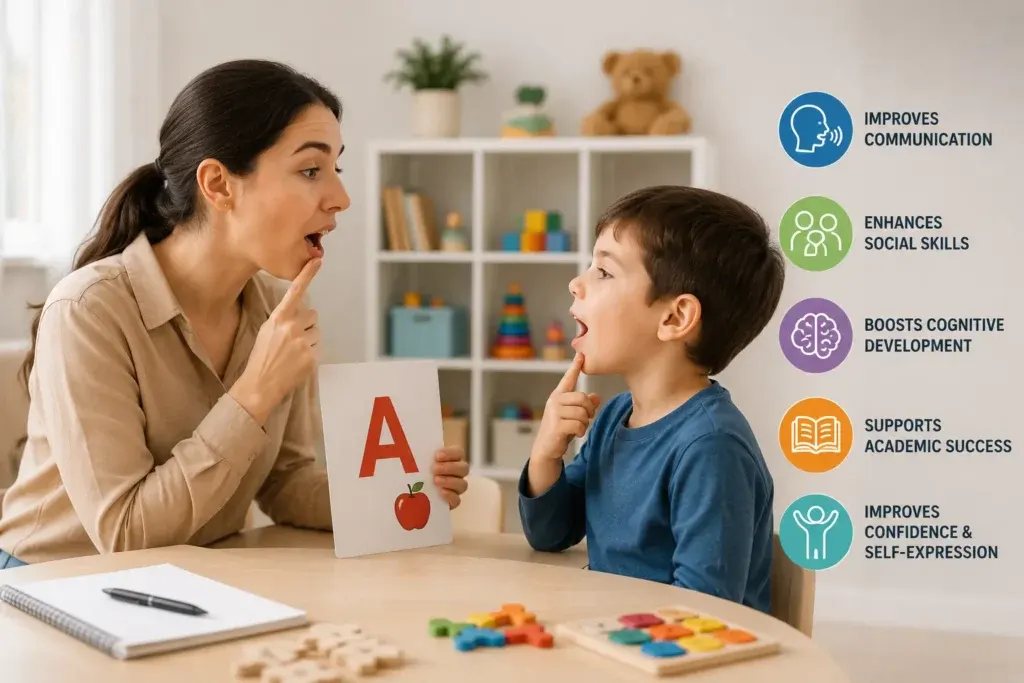
At its core, speech therapy is a structured process led by Speech-Language Pathologists (SLPs). These specialists work directly on the physical mechanics of producing sound while simultaneously strengthening the neural pathways required to process language. To build functional communication, a speech therapy program focuses on five key pillars:
This systematic approach makes therapy highly effective for a wide variety of people. Anyone experiencing structural communication issues, voice disorders, or physical swallowing difficulties can find measurable relief through clinical intervention.
Speech therapy provides comprehensive intervention that improves communication, learning, social interaction, and physical health. Because the program focuses on both cognitive processing and muscular coordination, it delivers several life-changing benefits for individuals at every stage of life:
It strengthens oral muscles and trains the tongue, lips, and jaw to produce distinct sounds accurately. This makes everyday speech instantly clearer and easier for family members, teachers, and colleagues to understand.
It helps individuals bridge gaps in both expressive language (putting thoughts into words) and receptive language (processing and understanding what others are saying).
By reducing the fear of being misunderstood or struggling to speak, therapy removes conversational frustration. This directly lowers social anxiety and builds deep self-esteem.
It teaches the unspoken rules of communication, such as maintaining comfortable eye contact, interpreting body language, understanding vocal tone, and mastering conversational turn-taking.
Clear speech and strong language comprehension are directly linked to reading, writing, and spelling readiness. Therapy gives children the cognitive tools required to follow instructions and participate in class.
It introduces advanced breath-control techniques, smooth vocal pacing, and gentle physical pausing strategies that minimize fluency blocks, helping individuals speak smoothly without tension.
For individuals suffering from voice disorders or vocal strain, therapy repairs pitch control, restores healthy vocal quality, and teaches safe projection techniques to prevent chronic throat fatigue.
Following a stroke or brain injury, targeted cognitive communication exercises help retrain the brain to locate forgotten words, construct sentences, and rebuild compromised cognitive pathways.
Because speech therapists specialize in the entire upper respiratory and oral muscle network, they train the throat and neck muscles to coordinate safe chewing, drinking, and swallowing mechanics.
Ultimately, therapy protects long-term autonomy. It allows young children to express their basic needs, helps adults advance in their careers, and assists seniors in maintaining cognitive function.
Because the human brain remains adaptable throughout life, targeted speech intervention yields profound benefits at any age, providing unique advantages across different life stages.
For young children, early intervention completely transforms their developmental and educational path. When a child struggles to express thoughts, the resulting frustration frequently manifests as behavioral outbursts, tantrums, or social withdrawal.
By utilizing specialized pediatric speech therapy in Delhi, clinical specialists transform intensive language training into engaging, play-based milestones. This targeted approach accelerates literacy by building the phonetic awareness required for reading and writing. Furthermore, it enhances social integration, giving children the exact tools they need to share toys, understand vocal tones, read peer facial cues, and regulate their emotions through clear words rather than behavioral acting out.
Adults seek out therapy for a wide range of reasons, from managing long-standing developmental conditions to recovering from sudden medical disruptions. Navigating these changes with professional adult speech therapy in Delhi allows individuals to handle their personal and professional landscapes with absolute clarity.
For those recovering from neurological challenges, therapy focuses heavily on word retrieval and rebuilding sentence structure. Professionally, clear communication serves as a massive asset; therapy helps adults refine public speaking, manage vocal volume, and alleviate severe communication anxiety during high-stakes presentations. Additionally, because the same muscle groups control both speech and swallowing, therapy provides vital training to ensure adults can eat and drink safely, drastically reducing respiratory risks.
As individuals age, progressive conditions like Parkinson’s disease, Alzheimer’s, or dementia can slowly erode communication skills. Cognitive communication therapy plays a vital role here by preserving active memory recall, conversational abilities, and independent problem-solving for as long as possible. Keeping these lines of communication open allows seniors to stay deeply connected to their families, directly combating the isolation and depression frequently associated with aging.
Because communication challenges stem from diverse root causes, speech-language pathologists utilize targeted therapies for specific diagnoses. To show exactly how these interventions function, the table below highlights the primary conditions treated and how therapy actively resolves them:
Condition | How Speech Therapy Helps |
Speech Delay | Expands vocabulary and improves early phonetic development. |
Stuttering | Enhances speech fluency, breathing control, and conversational confidence. |
Apraxia of Speech | Rebuilds the brain-to-muscle motor planning required to form words. |
Dysarthria | Strengthens weak oral muscles to clear up slurred or quiet speech. |
Autism Spectrum Disorder | Builds social interaction skills, conversational turn-taking, and nonverbal cues. |
Voice Disorders | Repairs vocal quality, pitch control, and healthy projection to reduce strain. |
Aphasia | Restores language retrieval and comprehension after a neurological event. |
Dysphagia | Trains the throat and neck muscles to ensure safe chewing and swallowing mechanics. |
To address these conditions effectively, therapists cannot rely on guesswork. Every successful program follows a definitive, structured treatment process designed to maximize long-term progress.
The speech-language pathologist conducts formal testing to evaluate speech clarity, language comprehension, and physical muscle function to identify the underlying root cause.
The therapist designs a custom roadmap with measurable benchmarks tailored directly to the individual’s lifestyle, challenges, and daily communication needs.
The individual participates in active, hands-on exercises ranging from targeted pronunciation drills and language games to vocal styling and muscle-strengthening exercises.
The therapist provides specific, structured exercises to be practiced at home, which actively stimulate neuroplasticity (the brain’s ability to rewire itself) and secure long-term retention.
Waiting for a communication challenge to improve on its own can cause individuals to miss out on the rapid progress associated with early intervention. Recognizing the warning signs early allows families to secure necessary professional evaluations.
Speech therapy goes beyond improving speech clarity. It helps individuals communicate more effectively in everyday situations, making daily interactions more comfortable, productive, and meaningful.
Everyday Setting | How Speech Therapy Helps |
At Home | Helps individuals express needs, thoughts, and emotions more clearly, reducing frustration and improving communication with family members. |
At School | Supports language development, classroom participation, reading readiness, and the ability to follow instructions with greater confidence. |
At Work | Improves communication during meetings, presentations, interviews, client interactions, and collaborative projects. |
In Social Situations | Enhances conversational skills, confidence, and the ability to build and maintain personal relationships. |
During Daily Activities | Makes everyday tasks such as making phone calls, asking for assistance, ordering food, or participating in community activities easier and more comfortable. |
While clinical sessions build the structural framework for success, the home environment plays a critical role in accelerating long-term retention.
Ultimately, speech therapy is about far more than just practicing pronunciation. It provides a dedicated pathway to connect with the world, build inner confidence, succeed academically, and maintain personal independence across every stage of life.
Navigating these communication adjustments becomes completely manageable when you have access to specialized clinical guidance. At Hearing Hope, our team works closely with individuals and families to provide detailed clinical evaluations and deeply personalized therapy plans. If you are ready to explore how dedicated clinical support can benefit you or your loved one, reach out to the professional team at Hearing Hope today to discover your best path forward.
Navigating speech struggles or missing communication milestones shouldn’t be a source of stress. Reach out to our specialist team at Hearing Hope today to schedule a comfortable, objective assessment and get the precise clarity you need.
The editorial team at Hearing Hope intends to share expert-certified information on hearing loss, hearing tests, and hearing care solutions. We aim to ease your journey and provide you with reliable information and aid.
Get In Touch
Yes. Adults can benefit from speech therapy at any age. Treatment can improve speech clarity, communication confidence, voice quality, language skills, and recovery after neurological conditions.
The number of sessions varies depending on the individual's age, diagnosis, severity of the condition, and therapy goals. Some people improve within a few months, while others may require longer-term support.
Yes. Speech therapists use articulation exercises and motor speech training techniques to improve pronunciation and make speech easier for others to understand.
Yes. Regular home practice reinforces therapy techniques, strengthens learning, and often helps individuals achieve faster and more sustainable progress.
Yes. Speech therapy assists children on the autism spectrum by developing functional verbal communication, mastering nonverbal gestures, understanding social cues, and building comfortable interaction skills with peers.
When selecting specialized speech delay therapy in Delhi, parents should prioritize licensed centers that offer thorough, data-driven diagnostic baselines. Effective programs focus on child-led, play-based intervention methods that actively pair pronunciation work with functional vocabulary expansion.
Choosing a center that integrates customized home-training guides alongside formal clinical work ensures optimal progress and prevents early communication gaps from turning into academic setbacks.
Because every brain and diagnosis is unique, timelines vary. However, many individuals experience clear, measurable progress within 3 to 6 months of consistent weekly sessions, especially when clinical techniques are reinforced daily through home practice.
Yes. Much of the anxiety surrounding social settings stems from a fear of stuttering, being misunderstood, or failing to find the right words. By improving structural speech clarity and teaching real-world conversation strategies, therapy directly reduces situational anxiety.
Not at all. Alongside major developmental and neurological conditions, speech therapy regularly treats mild voice strain, minor articulation adjustments, accent modification, and subtle cognitive organization challenges.
Yes. Reclaiming the ability to express yourself clearly removes conversational frustration, which directly increases self-esteem in social, academic, and professional environments.
Children can be evaluated and begin therapy as early as 18 months to 2 years old if they are missing critical communication milestones. Implementing early intervention typically leads to faster, more sustainable outcomes.
Yes. Speech therapy is a foundational component of stroke rehabilitation, focused specifically on retraining the brain to access vocabulary, clear up slurred speech, and restore physical swallowing safety.