Investing in your hearing is one of the most important decisions you can make for your long-term health, career, and relationships. Yet, when you start looking into modern solutions, navigating the financial aspect can feel overwhelming.
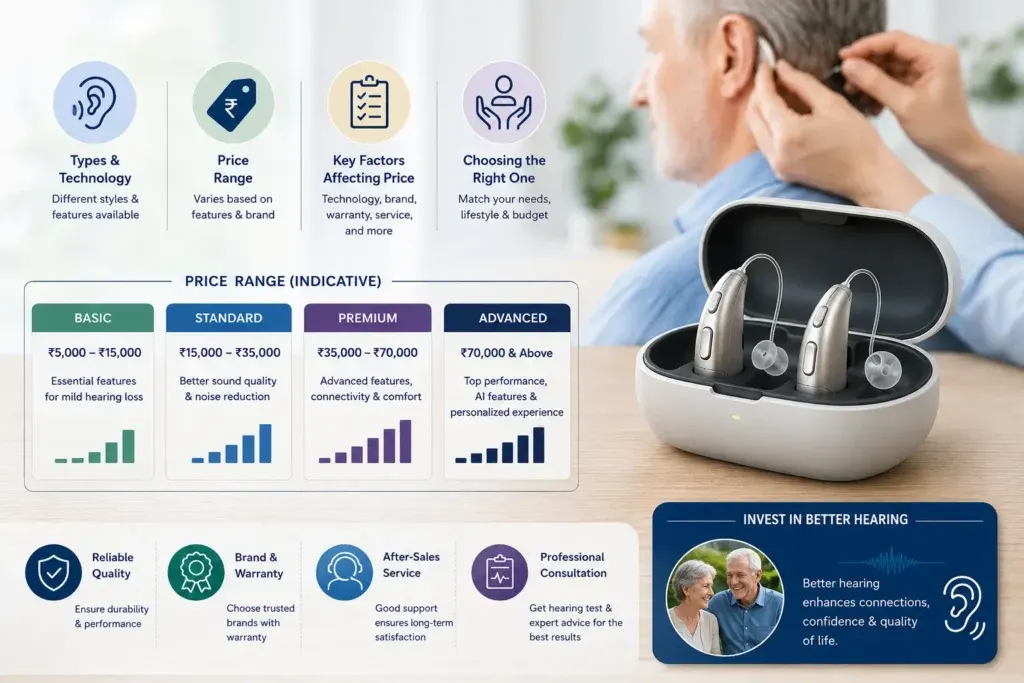
Digital hearing aid machine prices in India typically range from ₹11,000 to over ₹4,50,000 per ear. The final cost depends heavily on the internal technology level, processing features, brand selection, and your specific hearing loss requirements. While entry-level models provide basic amplification for quiet settings, advanced hearing aids leverage artificial intelligence, seamless Bluetooth connectivity, and automated noise reduction to help you thrive in the most demanding environments.
It is a common misconception that you are paying for the plastic shell or the physical size of a hearing aid. In reality, the cost is driven almost entirely by the sophisticated microcomputing hardware packed inside the casing.
Several key elements dictate the final pricing structure:
To help you understand what you get at different price points, hearing aids are categorized into technology tiers based on their processing channels, noise suppression capabilities, and automation.
Technology Tier | Average Price Range (Per Ear) | Key Features | Best For |
Entry-Level | ₹11,000 – ₹30,000 | 4–8 Channels, Manual volume control, and Basic feedback cancellation. | Quiet home environments, one-on-one conversations. |
Mid-Range / Essential | ₹30,000 – ₹1,00,000 | 12–16 Channels, Basic Bluetooth streaming, and Rechargeable options. | Mildly noisy environments, small group gatherings, and office work. |
Advanced | ₹1,00,000 – ₹2,50,000 | 20–24 Channels, AI speech tracking, Automatic environment switching. | Active lifestyles, frequent restaurant dining, and driving. |
Premium Flagship | ₹2,50,000 – ₹4,50,000+ | 48+ Channels, Deep Neural Networks (DNN), Health tracking, Spatial acoustics. | Dynamic, highly noisy environments, public speaking, and music lovers. |
The Indian market features premium global manufacturers. Each brand offers different technologies, features, and listening experiences:
Known for crisp speech clarity and highly stylized, sleek designs.
Known for strong connectivity features and a wide range of hearing aid models.
Preferred choice for natural sound profiles and clear performance.
The physical shape of the device dictates its battery type and power potential, though it does not dictate the technology level.
Style | Starting Price | Visibility |
BTE (Behind-The-Ear) | ₹11,000+ | Visible |
RIC (Receiver-In-Canal) | ₹25,000+ | Less Visible |
CIC (Completely-In-Canal) | ₹30,000+ | Nearly Invisible |
IIC (Invisible-In-Canal) | ₹30,000+ | Fully Hidden |
User Type | Recommended Budget |
First-time users | ₹11,000–₹30,000 |
Retired individuals with moderate hearing loss | ₹30,000–₹1,00,000 |
Working professionals | ₹1,00,000–₹2,50,000 |
Frequent travelers and active lifestyles | ₹1,50,000+ |
Severe hearing loss | Audiologist recommendation |
To figure out exactly which tier matches your hearing profile, it is highly recommended to seek out the best hearing test in Delhi at an accredited diagnostic facility before buying.
Provides basic hearing support best suited for quiet environments, resting at home, or having simple one-on-one chats. They are suitable for basic hearing support in quieter environments and for first-time hearing aid users.
Offers better speech clarity and connectivity features. Devices in this tier handle mild environmental noise well and frequently feature rechargeable configurations. It offers a balance of affordability, speech clarity, and useful connectivity features.
Delivers advanced noise management, artificial intelligence features, and automatic sound adjustments that adapt immediately as you walk into crowded or noisy public spaces. It is designed for users who need advanced performance in noisy and demanding listening environments.
Feature | Entry-Level | Premium |
Noise Reduction | Basic | Advanced AI |
Bluetooth | Limited | Full Connectivity |
Rechargeable | Sometimes | Usually Included |
Automatic Adjustments | Limited | Real-Time |
Speech Clarity in Noise | Moderate | Excellent |
Price | Lower | Higher |
Whether a premium hearing aid is worth the investment depends on your lifestyle and listening needs. Someone who spends most of their time at home may benefit from an entry-level device, while professionals, frequent travelers, and socially active individuals often gain significant advantages from advanced features such as AI-powered speech enhancement, Bluetooth streaming, and automatic environment adaptation.
The best hearing aid is not necessarily the most expensive one. It is the device that matches your hearing loss, daily routine, and long-term communication goals. By evaluating your lifestyle budget tiers against the available technology, you can make a practical investment that directly improves your daily communication and clarity.
At the end of the day, investing in a digital hearing aid is not just about purchasing hardware; it is about protecting your cognitive health and staying actively engaged with the world around you. Make the right choice with Hearing Hope and find the perfect hearing aid that matches you, your lifestyle, and your budget.

The editorial team at Hearing Hope intends to share expert-certified information on hearing loss, hearing tests, and hearing care solutions. We aim to ease your journey and provide you with reliable information and aid.
Get In Touch
Digital hearing aids start at approximately ₹11,000 per ear in India. Entry-level models provide essential sound amplification and manual volume controls, making them ideal for individuals who spend most of their time in quiet, home environments.
The average price of a digital hearing aid in India ranges from ₹30,000 to ₹1,20,000 per ear. The final cost within this bracket heavily depends on the technology level, brand selection, and the service features included by your clinic.
The total cost for two hearing aids can range from approximately ₹22,000 to more than ₹9,00,000, depending on the technology level, brand, and features selected. Many people choose bilateral hearing aids to achieve better sound balance and speech understanding.
Mid-range digital hearing aids priced between ₹30,000 and ₹1,00,000 often provide the best balance of sound quality, noise reduction, connectivity features, and affordability for most users.
Coverage varies depending on your insurance provider and policy. Many standard health insurance plans do not fully cover hearing aids, although some corporate and specialized plans may offer partial reimbursement.
Most digital hearing aids last between 3 and 7 years with proper care, regular servicing, and professional adjustments.
The best hearing aid depends on the individual's hearing loss, dexterity, and lifestyle. Many seniors prefer rechargeable behind-the-ear (BTE) or receiver-in-canal (RIC) models because they are easy to handle and maintain.
While hearing aids can be purchased online, a professional hearing evaluation is recommended to ensure proper fitting, programming, and long-term hearing improvement.
At Hearing Hope, you can book your hearing test and find the right hearing aid too.
Advanced internal microchips drive up the cost of premium hearing devices. These high-end chips require substantial research and development to pack complex processing tools into a compact device.
Signia, Phonak, Widex, ReSound, Starkey, and Oticon are the leading brands in India. These global manufacturers maintain authorized distribution networks and clinical support centers across the country.
Yes, micro-styles like CIC and Invisible in Canal (IIC) models carry a price premium. Miniaturizing advanced processing components into a tiny, shell-like casing requires specialized engineering and custom manufacturing.
Yes, rechargeable hearing aids generally cost more than traditional zinc-air battery-operated models. They carry a premium due to the cost of built-in lithium-ion battery technology and the convenience of eliminating ongoing weekly battery purchases.
While technically possible with over-the-counter devices, it is strongly discouraged. A professional evaluation, or advanced diagnostic checks like a BERA test in Delhi for objective nerve pathway analysis, is vital to safely and accurately configure the internal microchip's frequencies to match your precise pattern of hearing loss.