
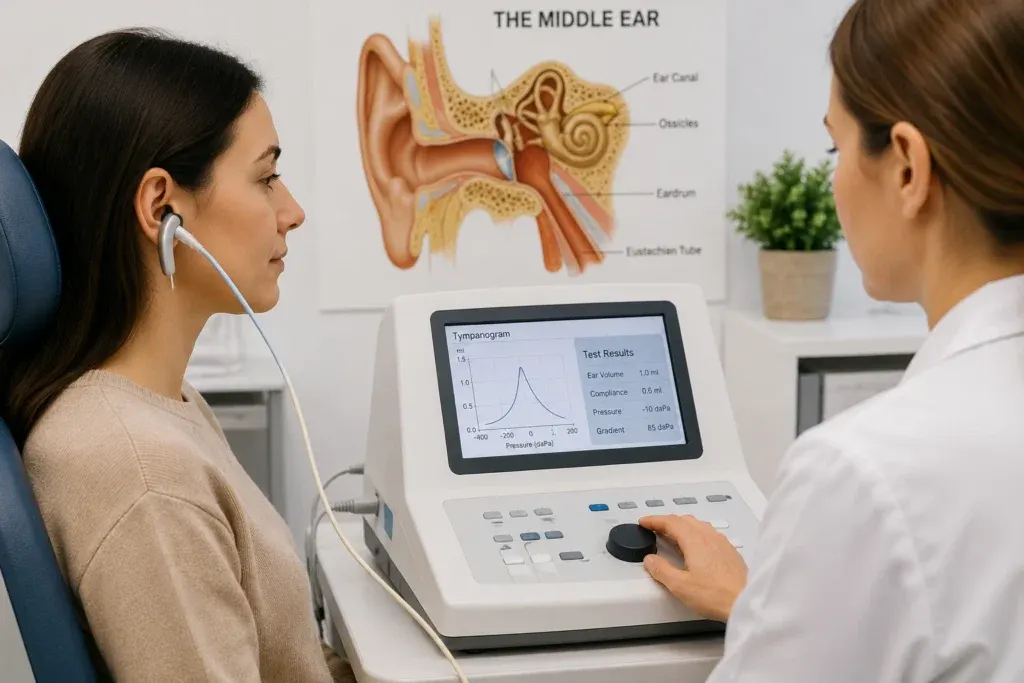
When you experience persistent ear discomfort, a muffled sensation in your hearing, or a deep ache that will not go away, the root cause often lies hidden directly behind your eardrum. Because you cannot see into the middle ear space with the naked eye, diagnosing these symptoms accurately requires specialized medical technology that goes beyond a standard visual inspection.
This is where an impedance audiometry test becomes essential. By measuring the physical mechanics and structural acoustic responses of your ear, this quick, objective, and gentle diagnostic evaluation uncovers exactly what is happening behind the scenes. It provides critical, real-time insights that help your doctor pinpoint structural issues, differentiate between conductive and sensorineural conditions, and map out the right path to effective relief.
Impedance audiometry (collectively referred to alongside immittance audiometry) is an objective, non-invasive diagnostic technique that assesses the health and functionality of the middle ear system. Unlike standard hearing tests that rely on your active participation, this test requires no verbal feedback.
It works by measuring the resistance (impedance) or ease of energy flow (admittance) within the middle ear as air pressure fluctuates. By providing precise, objective data about the eardrum and the tiny bones behind it (the ossicular chain), an impedance audiometry test plays a critical role in accurately diagnosing structural and conductive hearing disorders. This specialized exam is frequently performed alongside a standard audiometry test to provide a comprehensive view of your entire auditory pathway.
To get a complete picture of middle ear health, an impedance audiometry test evaluates two distinct mechanisms:
An audiologist or doctor will typically recommend this evaluation if you experience structural middle ear symptoms or specific clinical indicators, including:
The entire procedure is exceptionally fast, highly efficient, and completely comfortable, usually taking just a few minutes per ear. When you visit a specialized hearing test center, you can expect a streamlined, three-step process:
Step 1
Before inserting any testing equipment, the audiologist reviews your relevant medical history, focusing on past ear infections, surgeries, or sudden structural pressure changes. Next, they perform a physical inspection using an otoscope. This ensures your ear canal is entirely clear of impacted earwax, foreign objects, or active outer-ear infections that could alter the test data.
Step 2
Once your ear canal is clear, you will be asked to sit still, avoid talking, and refrain from swallowing for a few moments. A small, flexible probe tip covered in a soft rubber cuff is gently inserted into your ear canal to create a secure, airtight seal. The pump subtly changes the air pressure inside your canal while the speaker introduces a low-frequency probe tone.
Step 3
The diagnostic machine instantly translates these shifting physical responses into a visual chart called a tympanogram. This graph plots eardrum compliance (movement) along the vertical axis against air pressure levels along the horizontal axis.
Audiologists evaluate the shape, peak position, and ear canal volume on the tympanogram to categorize your middle ear function into highly specific diagnostic profiles:
Tympanogram Type | Graphic Profile | Clinical Meaning & Common Diagnoses |
Type A | A distinct, centered bell-shaped curve peaking near 0 daPa pressure. | Normal middle ear function. The eardrum moves perfectly, and pressure is balanced. |
Type As | A centered curve with an abnormally shallow, low peak. | Stiff middle ear system. Often indicates otosclerosis (fixation of the middle ear bones) or a thickened eardrum. |
Type Ad | A centered curve with a very high, off-the-chart peak. | Hyper-compliant eardrum. Points to a highly loose eardrum or a break in the bones of the ear (ossicular discontinuity). |
Type B | A completely flat line with no observable peak. | Fluid buildup or structural opening. If ear canal volume is normal, it indicates fluid (Otitis Media with Effusion). If the canal volume is unusually large, it confirms a perforated eardrum or a working patent tympanostomy tube. |
Type C | A normal-looking curve, but the peak is significantly shifted into negative pressure. | Eustachian tube dysfunction (ETD). Indicates that the tube connecting the ear to the throat is blocked, causing a vacuum effect (common during colds or allergies). |
Integrating an impedance test into your routine audiological workup offers distinct diagnostic advantages:
While impedance audiometry is an exceptional medical tool, understanding its scope ensures realistic health expectations:
By scheduling a comprehensive audiometry test, ENT specialists can quickly pinpoint exactly what is causing symptoms behind the eardrum:
Preparing for an impedance audiometry test requires very little effort, but keeping these simple guidelines in mind ensures the highest level of measurement accuracy:
After the test, an audiologist or ENT specialist reviews the findings to determine whether the middle ear is functioning normally.
Depending on the results, your healthcare provider may:
The test results help guide the next steps and ensure that treatment targets the actual cause of the problem.
An impedance audiometry test is a fast, painless, and highly effective diagnostic tool used to evaluate middle ear function. By measuring how the eardrum and middle ear respond to changes in pressure and sound, the test helps identify conditions such as fluid in the middle ear, Eustachian tube dysfunction, otosclerosis, and eardrum perforations.
Because the test provides objective and immediate results, it plays an important role in diagnosing middle ear problems and guiding the most appropriate treatment plan. If you are experiencing hearing difficulties, ear pressure, recurring infections, or unexplained ear discomfort, your hearing specialist may recommend an impedance audiometry test as part of a complete ear health evaluation.
Tired of that clogged, popping sensation or constant ear pressure? Connect with Hearing Hope to book a quick, painless impedance test in Delhi and find a clear solution that fits your lifestyle and budget perfectly.

The editorial team at Hearing Hope intends to share expert-certified information on hearing loss, hearing tests, and hearing care solutions. We aim to ease your journey and provide you with reliable information and aid.
Get In Touch
Regular pure tone audiometry is a subjective test that determines the quietest sounds you can hear across various pitches, requiring you to push a button or raise your hand. Impedance audiometry is an objective test that measures the physical movement and pressure mechanics of your middle ear structures automatically, requiring no behavioral response from you.
No, the test is completely painless. You will feel a brief sensation of mild pressure variations inside your ear canal, similar to the feeling of changing altitudes quickly in an airplane elevator, accompanied by a soft hum or clicking sound, but it causes no discomfort.
Most impedance audiometry tests take between 5 and 10 minutes. The procedure is quick, painless, and provides immediate results that help evaluate middle ear function.
Yes. Because the test does not require verbal responses, it is commonly used for infants, children, and individuals who may have difficulty participating in traditional hearing tests.
Ear canal volume is crucial for differentiating why the eardrum isn't moving. For instance, a flat line (Type B) with a normal canal volume usually means there is heavy fluid trapped behind an intact eardrum. However, a flat line paired with an unusually large volume reading tells the clinician that the probe is measuring the space of both the outer canal and the middle ear cavity, indicating a hole in the eardrum.
Yes, absolutely. A cold, sinus infection, or severe nasal allergy can easily block your Eustachian tubes, preventing air from properly ventilating your middle ear. This typically shows up on your graph as a Type C tympanogram, indicating high negative pressure.