
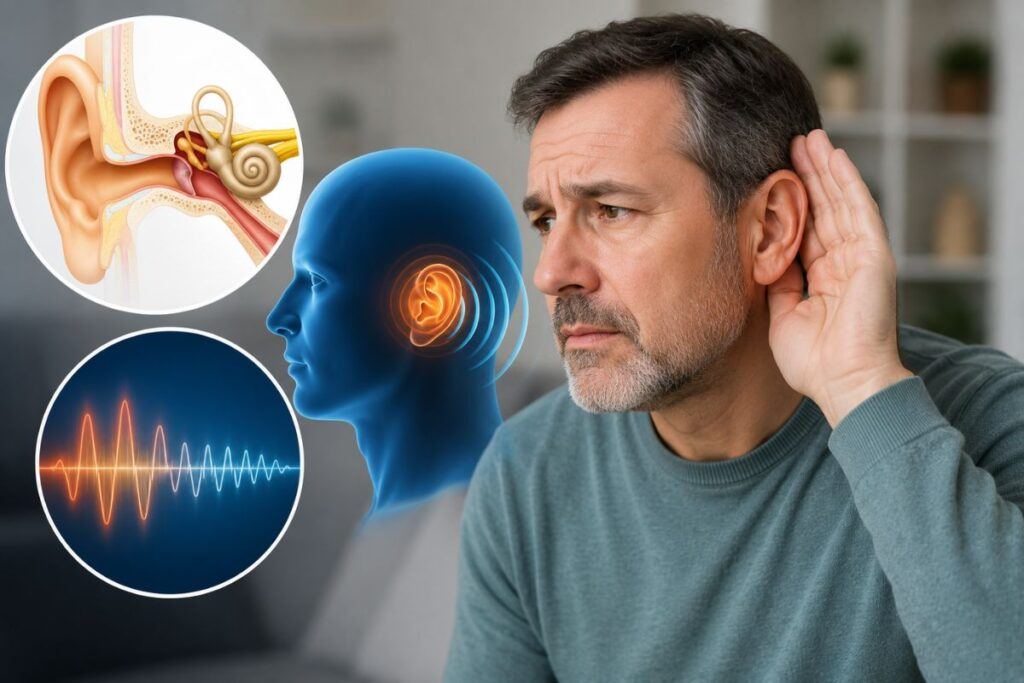
Low-frequency hearing loss is a less common type of hearing loss that affects a person’s ability to hear deep or low-pitched sounds. Unlike age-related hearing loss, which usually affects high-frequency sounds first, this condition makes it difficult to hear bass tones, deep voices, and low environmental sounds, while higher-pitched sounds may remain clear.
Many people describe the experience as hearing speech but missing its fullness and clarity. A male voice may sound muffled, music may lose its bass, and conversations in noisy places can become increasingly difficult to follow. Because symptoms can develop gradually or appear suddenly, understanding the condition is essential for early diagnosis and effective treatment.
In this comprehensive guide, you’ll learn about the causes, hearing loss symptoms, diagnosis methods, treatment options, prevention strategies, and the latest hearing aid solutions available for low-frequency hearing loss.
Question | Answer |
What is it? | Hearing loss affecting low-pitched sounds between 125 Hz and 500 Hz |
Common causes | Meniere’s disease, genetics, infections, autoimmune conditions |
Symptoms | Difficulty hearing deep voices, muffled speech, tinnitus, ear fullness |
Can it be treated? | Some causes are reversible; others require hearing aids or medical management |
Is sudden hearing loss an emergency? | Yes, immediate medical evaluation is recommended |
Low-frequency hearing loss occurs when an individual has difficulty hearing sounds within lower frequency ranges, typically between 125 Hz and 500 Hz.
Low-frequency sounds include:
This type of hearing loss is often referred to as reverse-slope hearing loss because of how it appears on an audiogram. Hearing thresholds are poorer at lower frequencies and improve as frequencies increase.
Compared to other forms of hearing impairment, low-frequencythis type of hearing loss is relatively uncommon and may be linked to inner ear disorders, genetic conditions, infections, autoimmune diseases, or sudden hearing loss.
Many people think that losing their hearing just means the whole world sounds quieter. But losing low sounds changes how clear the world is, not how loud it sounds.
In a completely quiet room, your hearing might feel perfectly normal. The real struggles show up during everyday routines:
A classic sign of this condition is being able to hear a woman or a child clearly, but struggling to understand a man with a deep voice. His voice turns into a low, rumbling hum. Because you can hear high sounds perfectly, it often feels like the man is just mumbling.
Music completely loses its beat, depth, and rhythm. You can hear the singer’s high notes and the crisp ring of cymbals perfectly, but the bass guitar and kick drums vanish. The songs sound like they are playing out of a tiny, cheap phone speaker.
Because this condition is rare, the early warning signs are often missed or blamed on other people speaking poorly. Look out for these common hearing loss symptoms:
Not all hearing issues start in the same part of the ear. Doctors divide this impairment into three distinct types:
This type happens when something physically blocks sound waves from traveling through the outer or middle ear to the inner ear. It acts like a physical barrier that selectively damps out deep bass vibrations.
This type occurs when there is permanent damage to the tiny hair cells inside the inner ear or the auditory nerve itself. It is the most common permanent type of hearing loss and requires electronic help to manage.
Mixed hearing loss is a combination of both conductive and sensorineural problems. It means there is a physical block in the middle ear at the same time as nerve damage in the inner ear.
This condition is uncommon because it requires highly specific damage to the apex. The apical region of the cochlea primarily processes low-frequency sounds, while the basal region is responsible for higher frequencies.
├─► Meniere’s Disease (Fluid Pressure)
├─► Genetics & Family Traits
├─► Autoimmune Inflammation
└─► Vascular & Poor Circulation Issues
This is an inner ear disorder caused by abnormal fluid buildup. It is one of the most prominent causes of a drop in low pitches. It classically creates a fluctuating hearing loss, which means your ability to hear deep tones changes from day to day.
Some individuals are born with subtle structural differences in the apex of the cochlea due to inherited family traits. Family history often plays an important role, causing the condition to develop gradually or be present from birth.
Sometimes, the body’s immune system gets confused and attacks healthy cells inside the inner ear. This causes sudden inflammation and blocks low frequencies from being processed correctly.
Severe middle ear infections (Otitis Media) can cause thick fluid to pool behind the eardrum. This fluid creates a heavy barrier that physically blocks low-pitched vibrations.
Physical injuries from sports, falls, or accidents can fracture the delicate bones of the middle ear or damage the apical hair cells in the cochlea, cutting off low-frequency pathway signals.
The inner ear depends heavily on constant blood flow to supply oxygen to its hair cells. Conditions like high blood pressure, diabetes, and clogged arteries restrict these tiny blood vessels, causing the low-frequency hair cells to break down. Smoking also restricts these vessels, starving the ear of oxygen.
Certain strong medications can accidentally cause toxicity and damage inner ear structures. This includes specific aminoglycoside antibiotics, loop diuretics, and some chemotherapy drugs.
While age-related decline usually destroys high frequencies first, some individuals experience a rare pattern of aging where the apical hair cells degrade first, pulling down the lower register of their hearing.
Yes. Any sudden loss of hearing is a true medical emergency. If you notice a sudden drop in your ability to hear low pitches, you must take action immediately to protect your ears.
The condition can present itself symmetrically across both ears or isolate itself to just one side, depending entirely on the underlying trigger.
Unilateral means the hearing loss happens in only one ear. This pattern is typically caused by localized problems, such as Meniere’s disease, severe middle ear infections, physical trauma to one side of the head, or a sudden viral attack on a single auditory nerve.
Bilateral means the hearing loss affects both ears at the same time. This symmetrical pattern is usually driven by systemic issues that affect the entire body, including inherited genetic traits, chronic cardiovascular conditions, age-related tissue breakdown, or exposure to ototoxic medications.
Tinnitus is the medical term for hearing phantom noises that do not exist in the outside world. It is a highly common partner to low-frequency hearing loss.
Finding a low-frequency drop requires a series of specialized diagnostic evaluations performed by a professional audiologist:
The results of your hearing tests are plotted on a graph called an audiogram. This chart tracks the pitch of a sound from low to high against your ability to hear it.
On a standard test chart, regular hearing loss curves downward like a ski slope. But with a low-frequency drop, the line does the exact opposite. It starts low on the left side (poor bass hearing) and climbs steadily toward the top right (normal treble hearing). Because it is the exact inverted image of a normal decline, it is called a reverse-slope audiogram.
The severity of the loss is determined by how many decibels ($dB$) of volume must be added before you can perceive a sound across different frequency markers.
Level | Impact on Daily Life |
Mild | Soft environmental rumbles and deep musical lines disappear. |
Moderate | Missing structural parts of words; men’s voices sound consistently muffled. |
Severe | Can only perceive heavy physical vibrations or shouting up close. |
Whether your hearing can be restored depends entirely on what part of your ear was damaged. Conductive blocks can usually be cleared, while permanent nerve damage requires long-term technical management.
Underlying Cause | Type of Loss | Recovery Potential |
Middle Ear Infection | Conductive | High — Hearing returns once the infection clears. |
Fluid Build-Up | Conductive | High — Medical drainage or decongestants restore the pathway. |
Meniere’s Disease | Sensorineural | Partial — Hearing fluctuates; it can be stabilized but is rarely fully cured. |
Noise Damage | Sensorineural | Low — Broken cochlear hair cells cannot regrow naturally. |
Genetic Causes | Sensorineural | Low — Permanent structural changes require electronic assistance. |
Once a doctor identifies the exact cause of your reverse-slope pattern, they will deploy a targeted combination of medical, surgical, or digital solutions.
For individuals with a profound, permanent sensorineural loss where traditional hearing aids no longer provide any clarity, a cochlear implant may be recommended. This device bypasses the damaged cochlea entirely and sends electrical signals directly to the auditory nerve.
Managing a reverse-slope pattern requires a highly specialized approach because standard, out-of-the-box programming rules are designed entirely for high-frequency loss.
Most basic hearing aid configurations are programmed to automatically turn down low-frequency bass sounds and boost high-pitched treble. If a patient with a reverse-slope pattern uses a standard setting, the device will make high frequencies blindingly loud and shrill, while doing absolutely nothing to fix the missing bass sounds. This causes immediate listening frustration.
The ideal style for a low-frequency drop is an open-fit device. This design features a non-occluding tip that leaves the ear canal open. This allows natural high-pitched sounds to pass into your ear completely naturally, while the hearing aid speaker focuses entirely on generating the missing low-pitched tones.
Modern digital hearing aids feature multiple adjustment channels. An audiologist must manually adjust your prescription channel-by-channel. This allows them to carefully boost the low-frequency channels without creating an “upward spread of masking”—a phenomenon where loud bass sounds accidentally drown out your remaining high-frequency hearing.
Advanced hearing technology now utilizes artificial intelligence to scan your environment up to $10,000\text{ times}$ per second. If you walk into a noisy room, the AI instantly recognizes the low-frequency rumble of background noise and separates it from the speech frequencies, keeping conversations crystal clear without forcing manual adjustments.
Modern devices feature direct Bluetooth streaming. This allows audio from your phone, television, or laptop to stream directly into your ears, bypassing the low-quality room speakers that naturally clip out deep bass tones.
To get the most out of these advanced features, it is vital to have your device programmed by an expert. Scheduling an evaluation at a dedicated hearing aid center in Delhi or your local specialty clinic ensures that your device is customized precisely to your unique reverse-slope audiogram.
When your hearing changes constantly due to conditions like Meniere’s disease, navigating daily life can feel like a moving target.
Ignoring a reverse-slope hearing impairment can lead to serious, long-term consequences for your mental and physical health.
While you cannot prevent genetic traits or sudden autoimmune attacks, you can take smart everyday steps to minimize your risk of structural ear damage.
Heavy industrial machinery, loud concert subwoofers, and engine rumbles can fatigue and damage your cochlea over time. Always wear high-quality earplugs or noise-canceling earmuffs when working around heavy equipment or attending live music events.
Keep your inner ear hair cells rich with oxygen by protecting your blood circulation. Eat a balanced diet, exercise for at least $30\text{ minutes}$ a day, and avoid smoking to protect your micro-circulation pathways.
If you live with diabetes or high blood pressure, keep them well-managed through close coordination with your doctor. Uncontrolled blood sugar levels and poor circulation can damage the fragile auditory nerve pathways over time.
Do not wait until the world sounds muffled to check your ears. Getting a baseline professional hearing evaluation allows your audiologist to catch subtle threshold drops early before they progress into noticeable daily impairments.
Review this quick symptoms checklist. If you check two or more of these boxes, you should book a comprehensive professional hearing test:
Low-frequency hearing loss may be less common than other forms of hearing impairment, but its impact on communication, safety, and quality of life can be significant. Because symptoms often develop gradually or resemble everyday listening difficulties, many people ignore the early warning signs. Whether the cause is Meniere’s disease, an ear infection, a genetic condition, or sudden hearing loss, early diagnosis offers the best opportunity to protect your hearing and prevent further deterioration.
Modern diagnostic tools, advanced hearing aid technology, and specialized treatment plans make it possible for many individuals to manage the condition successfully. If you have noticed muffled speech, difficulty hearing deep voices, persistent tinnitus, or other hearing loss symptoms, scheduling a professional hearing evaluation is the most important step toward preserving your long-term hearing health.
Figuring out why deep voices sound muffled or why background noise feels like a heavy hum shouldn’t be a stressful process. Contact our specialist team today to schedule a comfortable, objective assessment and get the precise diagnostic clarity you need.

The editorial team at Hearing Hope intends to share expert-certified information on hearing loss, hearing tests, and hearing care solutions. We aim to ease your journey and provide you with reliable information and aid.
Get In Touch
Yes. Low-frequency hearing loss is less common than high-frequency hearing loss and is often associated with conditions such as Meniere's disease, genetic factors, or specific inner ear disorders.
Deep male voices, bass instruments, thunder, engine noise, and some vowel sounds are often the most difficult to hear.
Yes. Depending on the underlying cause, hearing loss may remain stable, fluctuate, or gradually progress over time.
Yes, but only if the cause is temporary, like an infection or fluid buildup. If the loss is sensorineural (nerve damage), it is permanent and cannot be reversed.
It happens when the apex, or the top part of your inner ear cochlea, suffers damage. This specific area processes deep bass tones while the rest of the ear handles high pitches.
Yes, certain medical conditions can target only one ear while the other remains completely healthy. Localized issues do not always impact both sides of your hearing system.
Standard presets are built to boost high pitches and reduce low pitches, which is the exact opposite of what you need. Using a generic setting will make the world sound blindingly sharp without fixing the missing bass.
When your brain is starved of natural low-pitched sounds, it generates its own phantom noises to fill the quiet void. This creates a specific, low-pitched roaring or rushing tinnitus.