We often think of hearing loss as a simple on-and-off switch. You either hear perfectly or you live in total silence. In reality, your hearing health exists on a highly nuanced spectrum. You might notice that you can easily follow a quiet conversation at home, but the moment you enter a busy restaurant, words seem to blur together into an exhausting hum.
Because hearing changes usually creep up slowly over several years, it is incredibly easy to miss the early warning signs. That’s why understanding the precise degree of hearing loss, i.e., how much hearing ability a person has lost, is the single most important step in protecting your auditory pathways, reclaiming your communication confidence, and choosing the right steps toward clear sound.
The degree of hearing loss indicates the overall severity of a person’s hearing impairment. It ranges across a spectrum from normal hearing to profound silence.
Audiologists measure these levels in decibels (dB). A decibel hearing threshold represents the absolute quietest volume at which an individual can hear a specific sound frequency. The higher the decibel threshold number on a person’s chart, the more severe their hearing impairment is.
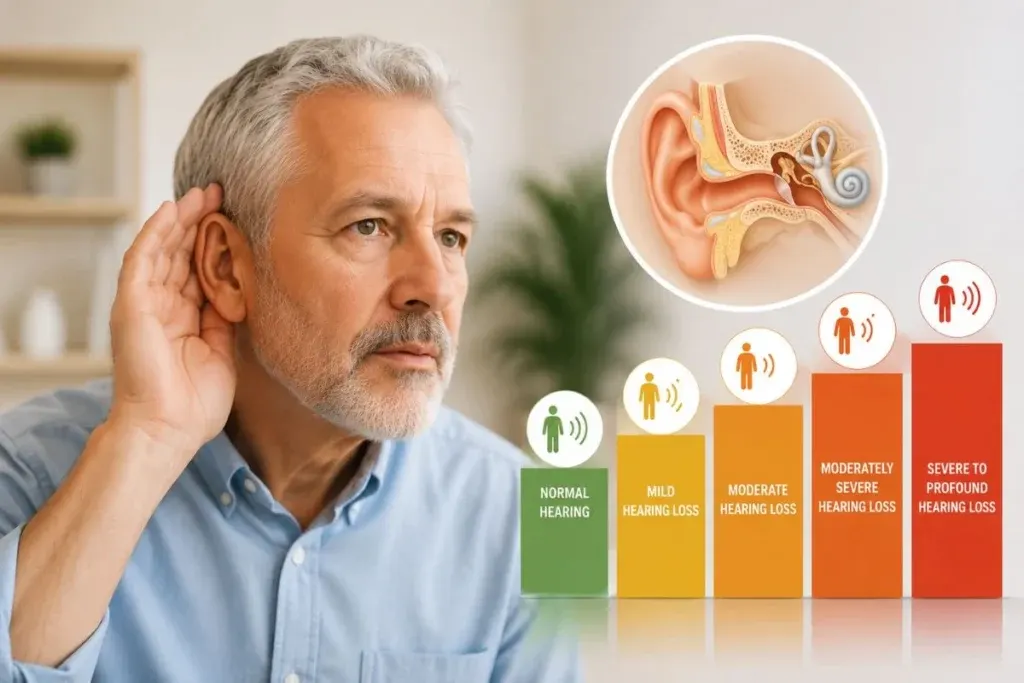
Audiologists use a standardized classification system to evaluate your test results. This chart categorizes the severity of an impairment based on the decibel (dB) levels an individual can comfortably process:
Degree of Hearing Loss | Threshold Range (dB) | Daily Impact and Description |
Normal Hearing | 0 to 25 dB | Can hear all normal environmental sounds and whispers without difficulty. |
Mild Hearing Loss | 26 to 40 dB | Difficulty hearing soft speech or distant sounds, especially in noisy rooms. |
Moderate Hearing Loss | 41 to 55 dB | Struggles to understand regular speech and normal conversational volumes. |
Moderately Severe | 56 to 70 dB | Conversations must be significantly louder or held close to the ear to be understood. |
Severe Hearing Loss | 71 to 90 dB | Normal speech is completely inaudible; it requires powerful amplification to hear any sound. |
Profound Hearing Loss | 91 dB or higher | Very little or no ability to perceive sound or speech without specialized implants. |
The specific challenges you face change depending on how far your decibel threshold shifts from normal baseline levels:
You may need to schedule a professional hearing test if you experience any of the following scenarios:
Audiologists use several tests to determine the severity and type of hearing loss during a comprehensive hearing assessment:
This core test measures the absolute quietest sounds you can hear across a wide range of high and low pitches. While wearing headphones in a soundproof room, you signal every time you hear a tone. Undergoing a professional PTA test in Delhi allows clinical specialists to systematically record these responses. The results are then plotted on an audiogram to create a clear, visual graph of your softest hearing thresholds.
This evaluation checks your real-world communication skills rather than just your response to electronic tones. It determines the lowest volume at which you can recognize spoken words and measures your percentage of speech clarity when background noise is introduced.
This assessment checks the physical health, air pressure, and mechanical movement of your eardrum and middle ear bones. Booking a specialized impedance test in Delhi helps clinical specialists identify if a physical blockage, Eustachian tube malfunction, or fluid accumulation is causing a drop in your hearing levels.
This test measures the acoustic response generated by the microscopic outer hair cells within your cochlea. A small probe is placed inside the ear canal to check for inner ear damage, which is incredibly useful for infants or individuals who cannot complete standard button-pressing tests.
Brainstem Auditory Evoked Response testing records the electrical wave activity along the hearing nerve pathway up to the brainstembrain stem. It provides an objective baseline to confirm whether sound signals are being delayed or disrupted by nerve pathway irregularities.
While “degree” describes the hearing severity level (how much hearing is lost), “type” describes where the physical problem is occurring within the auditory system. A person can have a mild degree of conductive loss or a severe degree of sensorineural loss.
While anyone can experience changes in their hearing thresholds, certain risk factors accelerate the progression from mild to more severe stages:
Medical interventions are highly customized according to the specific block on your decibel chart:
Tracking the precise degree of hearing loss is the most effective way to protect your long-term communication and quality of life. Hearing impairments develop across six distinct stages, ranging from mild shifts to profound silence, based on how high your decibel thresholds move during a clinical evaluation. Because early warning signs like muffled speech or turning up the television volume often worsen gradually, diagnostic tools are essential to catch these subtle structural changes early.
By undergoing targeted assessments to map out your hearing health, specialists can isolate whether the issue stems from a temporary blockage in the middle ear or permanent nerve damage in the inner ear. Understanding your exact stage allows audiologists to create a highly customized treatment plan tailored to your needs, whether that means standard medical care, custom digital hearing aids, or advanced surgical implants.
Knowing your exact degree of hearing loss is key to protecting your cognitive health and staying connected. Choose Hearing Hope to book a precise evaluation and find a customized solution that matches your lifestyle and budget.
The editorial team at Hearing Hope intends to share expert-certified information on hearing loss, hearing tests, and hearing care solutions. We aim to ease your journey and provide you with reliable information and aid.
Get In Touch
The degree of hearing loss refers to the severity of an individual's hearing impairment. It is categorized into levels ranging from mild to profound, determined by the quietest decibel (dB) level a person can hear during a test.
Hearing aids are commonly recommended for mild hearing loss (26-40 dB) onward when hearing difficulties begin affecting daily communication. They are generally advised for moderate hearing loss and above to improve speech understanding and listening comfort.
The degree of hearing loss is diagnosed through a PTA test in Delhi. During the test, an audiologist measures the quietest sound you can hear across different frequencies and records the results on an audiogram to determine the severity of your hearing loss.
Your hearing loss percentage is calculated by an audiologist using your audiogram results. The formula evaluates your hearing thresholds across key speech frequencies to determine your precise level of impairment for medical or official documentation.
The chart acts as a diagnostic reference tool for healthcare providers. It classifies a patient's hearing thresholds into distinct categories (Mild, Moderate, Severe, Profound) based on decibel levels, helping specialists recommend the correct hearing aid or medical treatment.
The stages align with the overall severity of the condition. It begins at the mild stage (trouble with soft speech), progresses to moderate (difficulty with normal conversations), advances to severe (only loud noises are audible), and can end at the profound stage (very little to no sound is perceived).
The most challenging type is profound sensorineural hearing loss. It is considered the most severe because it involves permanent, irreversible damage to the inner ear or the main hearing nerve, distorting both the volume and the clarity of sound.
Yes. Sudden loss in one ear can occur due to viral infections, circulatory problems in the inner ear, head trauma, or sudden blockages. It is classified as a medical emergency and requires immediate clinical evaluation to protect long-term function.