When you notice a drop in your hearing clarity or find yourself asking people to repeat themselves, it’s natural to feel uncertain about the next steps. The most critical foundation for identifying any hearing issue is a clinical evaluation called a pure-tone audiometry test, commonly abbreviated as a PTA test.
If you are unfamiliar with audiometric procedures, you might wonder what a PTA test for ear clinics looks for and how the process unfolds. This non-invasive evaluation maps your hearing abilities across various frequencies to give a clear picture of your hearing health. By scheduling an assessment through a qualified hearing test service, you can identify the cause and level of your hearing capacity and discover the best options to restore your clarity.
A pure tone audiometry evaluation is a behavioral test used to measure the softest sounds you can hear at different pitches or frequencies. It acts as the standard diagnostic benchmark in modern audiology. The term “behavioral” means it relies on your active responses during the assessment.
The test determines your hearing threshold, which is the softest level of sound you can perceive at least fifty percent of the time. The results are plotted on a specialized graph called an audiogram, which charts your hearing ability in both ears individually. This allows an audiologist to confirm if your hearing falls within a normal range or if a specific level of hearing loss is present.
Anyone experiencing subtle or obvious changes in their everyday listening capabilities should consider getting evaluated. It is particularly crucial for individuals who:
Struggle to follow conversations in busy or crowded rooms.
Increase the TV or radio volume frequently to levels others find loud.
Experience persistent ringing, buzzing, or hissing in the ears.
Work in noisy environments like factories, construction sites, or airports.
Are over 50 years old and want an annual baseline check.
Notice sudden or gradual hearing changes in one or both ears.
You need a comprehensive professional hearing aid evaluation.
An ear specialist recommends this clinical evaluation for several key diagnostic reasons:
Identify Hearing Loss Severity: The test measures whether your hearing loss is mild, moderate, severe, or profound.
Determine the Type of Loss: It helps distinguish between conductive issues involving the outer or middle ear and sensorineural problems involving the inner ear or auditory nerve.
Pinpoint the Affected Pitch: Some individuals can hear deep bass sounds perfectly fine but struggle with high-pitched frequencies like birds chirping or children speaking.
A person who finds it difficult to hear conversations in busy restaurants but hears well in quiet rooms may have high-frequency hearing loss. A PTA test helps identify the affected frequencies, allowing the audiologist to recommend the most suitable treatment or hearing aid settings.
Preparing for the evaluation is incredibly simple and requires no major lifestyle disruptions. Following these practical steps ensures your results are highly accurate:
The PTA test is simple, painless, and does not require injections or medication. Most appointments take between 20 and 30 minutes, and you can return to your normal activities immediately after the test.
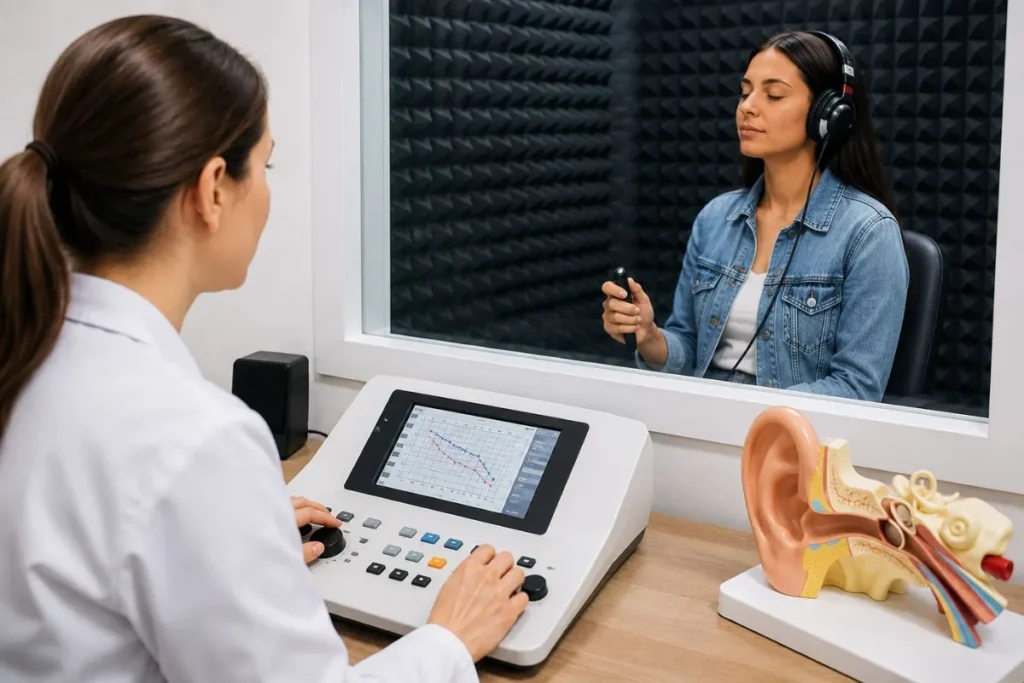
You will sit comfortably inside a specially insulated soundproof room or booth. This controlled environment ensures that everyday ambient sounds like air conditioners, street traffic, or hallway footsteps do not interfere with your ability to perceive faint tones.
The audiologist will place a pair of calibrated headphones over your ears or insert small foam tips directly into your ear canals. This part of the test checks how sound travels through your entire auditory system. You will hear a series of pure tones or beeps at varying pitches and volumes, usually starting in one ear and shifting to the other. Every time you hear a tone, even if it is exceptionally faint, you will press a handheld button or raise your hand to signal the specialist.
Next, the specialist removes the headphones and places a small vibrating device called a bone oscillator against the hard bone right behind your ear or on your forehead. This device bypasses the eardrum and middle ear space entirely, sending gentle vibrations directly to the fluid inside your inner ear. Just like the first step, you will signal whenever you perceive a tone. Comparing these two distinct assessments allows the professional to pinpoint exactly where any blockages or nerve damage might be sitting.
After the test, your responses are recorded on an audiogram. This graph helps the audiologist understand how well you hear sounds at different frequencies and volumes, making it easier to identify the type and severity of hearing loss.
The findings are recorded on a graph that sets frequency, measured in hertz, along the horizontal axis and intensity, measured in decibels, along the vertical axis. A normal hearing threshold for healthy adults sits anywhere between minus ten and twenty decibels. If your thresholds sit higher than twenty-five decibels, it indicates some degree of hearing decline. The difference between your air conduction and bone conduction lines tells the audiologist if the problem is a simple physical blockage, like impacted earwax or fluid behind the eardrum, or a permanent nerve desensitization that requires electronic correction.
Once the evaluation is complete, the diagnostic journey shifts toward analyzing the data and establishing a personalized care path:
Prioritizing a comprehensive evaluation from a certified professional is the most essential factor in getting reliable results. Finding a trusted local provider ensures easy access to follow-up care and routine checks. When looking for a reliable provider, checking for a dedicated hearing test service that includes speech clarity evaluations alongside standard testing provides a much better picture of your daily communication needs.
For residents living in the capital region, choosing a well-reviewed clinic for a hearing test in Delhi ensures you receive care from experienced specialists equipped with modern diagnostic tools. When selecting a clinic, look for the following core criteria:
Choosing a trusted provider ensures accurate results and appropriate recommendations based on your hearing needs.
A PTA test for the ear is one of the most reliable ways to evaluate your hearing and identify the type and severity of hearing loss. From understanding how the test works to learning how the results can guide treatment, this assessment provides valuable information for protecting your long-term hearing health.
If you notice changes in your hearing, scheduling a professional hearing test is an important first step. For those looking for a hearing test in Delhi, choosing an experienced clinic with qualified audiologists and modern equipment can help ensure an accurate diagnosis and the right treatment plan.
Take control of your hearing with an accurate PTA hearing test at Hearing Hope. Our expert audiologists provide precise assessments and personalized solutions to help you hear every moment with confidence. Book your hearing assessment today.
The editorial team at Hearing Hope intends to share expert-certified information on hearing loss, hearing tests, and hearing care solutions. We aim to ease your journey and provide you with reliable information and aid.
Get In Touch
A pure tone audiometry test is used to find the softest sound you can hear at multiple frequencies. It tells your specialist the exact degree and type of hearing loss you have, allowing them to create a personalized treatment plan.
No, a PTA (Pure Tone Audiometry) test is completely painless and non-invasive. During the test, you simply wear headphones or a bone conduction device and respond whenever you hear a sound. The procedure does not involve injections, medication, or surgery, and most people complete it comfortably within 20 to 30 minutes.
No, fasting is not required before a PTA test. You can eat and drink as usual before your appointment. To help ensure accurate results, avoid exposure to loud noise for at least 24 hours beforehand and let your audiologist know if you have an ear infection, excessive earwax, or are taking medications that could affect your hearing.
Anyone experiencing symptoms like trouble following conversations, needing to raise the television volume, or experiencing persistent ringing in the ears should get tested. Adults over 50 are also encouraged to get it as a routine screening.
The entire testing process is fast and efficient. It usually takes between 20 and 30 minutes to test both ears across all key frequencies.
Yes, children can undergo this test, provided they are old enough to understand the instructions and respond reliably to the beeping sounds, which is typically around 4 or 5 years of age. For younger infants, specialized automated screening tests are utilized.
You must avoid exposing your ears to excessively loud sounds like concerts, firearms, loud headphones, or noisy workspace machinery for at least 24 hours prior to your scheduled slot to avoid temporary ear fatigue.
Yes, the audiologist plots your responses onto the audiogram immediately during the procedure, meaning you will receive your results and a complete consultation on the very same day.