
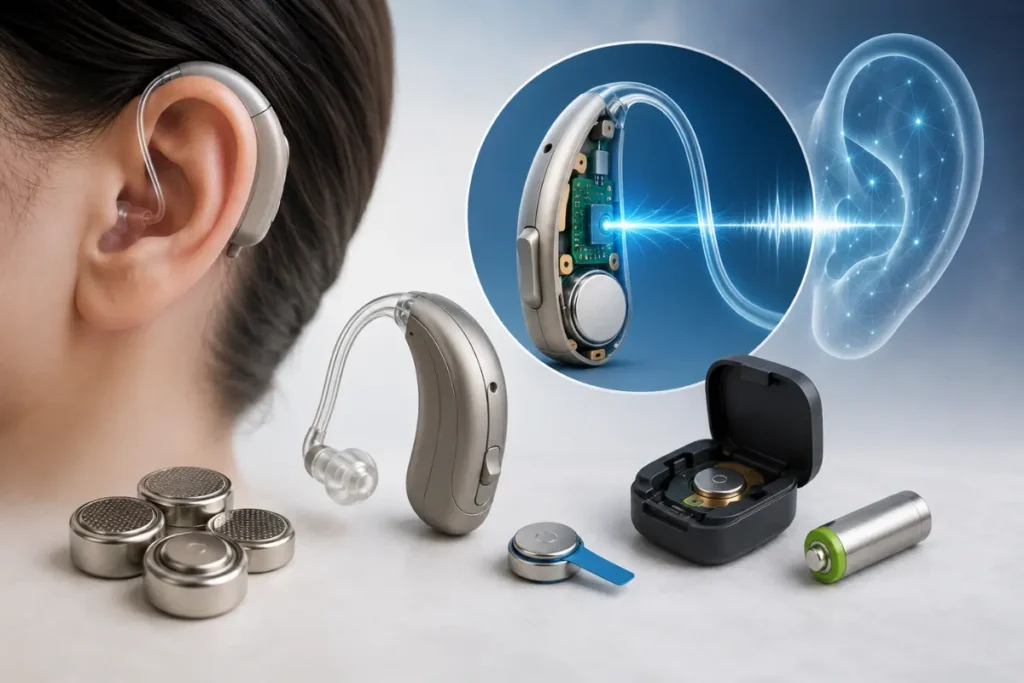
Every feature your hearing aid offers, from background noise reduction and automatic environment switching to Bluetooth calls and AI-powered speech processing, draws from a single source: the battery. Pick up any modern hearing aid, and the power cell inside it determines not just how long the device lasts but also which features it can run and how reliably it performs under the demands of a full day.
Currently, Zinc-air button cells and Lithium-ion batteries own the hearing aid battery market. One has been powering hearing aids for decades, and the other has become the benchmark in premium and mid-range devices over the past five years. The two technologies work differently, suit different users, and involve very different long-term costs and habits.
This guide explains how each power source works, what it can and cannot do, which battery size fits which hearing aid style, and how your specific lifestyle and daily hearing demands should guide the choice.
Feature | Zinc-Air Platforms (Disposable) | Lithium-Ion Platforms (Rechargeable) |
Power Style | Replaceable button cells | Built-in, sealed internal cell |
Average Lifespan | 3 to 20 days per battery | 4 to 5 years total battery lifecycle |
Daily Upkeep | Manual battery swaps | Overnight docking |
Dexterity Required | High (handling tiny components) | Low (simple drop-in charging) |
Wireless Streaming | Modest (drains cells quickly) | Excellent (built for heavy power draw) |
In recent years, the role of the hearing aid battery has fundamentally changed. Previously, a micro-cell had a single responsibility: to provide basic current to a standard acoustic amplifier.
Today, a modern premium hearing instrument operates as a wearable, high-performance computer. A single power cell must simultaneously support a heavy processing load, including:
Because processing power and wireless connectivity require more energy, traditional disposable battery lifecycles can drop significantly when these heavy-draw features are used continuously throughout the day.
Sealed rechargeable lithium-ion cells have become the premium industry standard for mid-to-high-tier devices. Their high energy density and stable voltage delivery are explicitly engineered to handle high-frequency power spikes without causing sudden audio drops or distortion.
The Key Takeaway: Understanding the exact battery architecture inside your hearing instrument is no longer just about convenience. It is essential for managing your daily habits, protecting your device’s audio clarity, and preventing unexpected power loss at critical moments.
Zinc-Air Button Cells: How They Work and What to Expect
Zinc-air cells generate electricity through a chemical reaction between zinc and atmospheric oxygen. Each battery is manufactured with microscopic pores in its casing, sealed at the factory by a small adhesive tab. The tab keeps the cell in a dormant, shelf-stable state. When the tab is removed, oxygen enters through the pores and reacts with the zinc anode to produce a steady electrical current.
This is why zinc-air batteries cannot be stored once activated: once the tab is removed, the reaction begins and will not pause. It is also why the five-minute rule matters: after peeling the tab, leave the battery in open air for five minutes before inserting it. This allows full oxygen saturation of the cell and ensures it reaches its rated voltage capacity from the start.
Zinc-air cells deliver a flat, consistent voltage discharge curve. Unlike some hearing aid batteries that gradually fade in output, zinc-air maintains steady voltage right up until the cell is nearly exhausted, at which point the device typically signals a low-battery alert. This consistent output is one reason zinc-air remained the hearing aid standard for so long.
The hearing industry uses a universal color-coded numbering system for zinc-air cells. The number and color are printed on the packaging and on the cell itself, making replacements straightforward to find.
Size | Colour Code | Common Device Types | Typical Runtime | Relative Capacity |
10 | Yellow | CIC and IIC (smallest, deepest-fit styles) | 3 to 7 days | Lowest |
312 | Brown | RIC and ITC (most popular current style) | 5 to 10 days | Medium |
13 | Orange | BTE and full-shell ITE | 6 to 14 days | High |
675 | Blue | High-power BTE and cochlear implant processors | 9 to 20 days | Highest |
Note on runtime ranges: The figures above represent typical usage at moderate activity levels without heavy Bluetooth streaming. Runtime shortens when streaming is active, the device is running advanced AI processing, or when the user is in environments requiring continuous directional processing. Runtime at the low end of each range is more likely in premium AI-enabled devices than in entry-level models.
Lithium-ion cells store and release energy through the movement of lithium ions between a positive electrode (cathode) and a negative electrode (anode) within a sealed, liquid electrolyte. Unlike zinc-air, no atmospheric exposure is involved. The cell is fully enclosed in the hearing aid casing and does not interact with the external environment during operation.
When placed on a charging dock, an electrical current is passed through the cell in reverse, driving the lithium ions back to the anode and restoring the stored energy. Lithium-ion cells do not suffer from the memory effect associated with older battery chemistries (such as NiMH): partial charges do not degrade capacity, and the cell does not need to be drained fully before recharging. Placing the hearing aids in the dock each night, regardless of remaining charge level, is the correct usage pattern.
Lithium-ion cells have a significantly higher energy density than zinc-air, meaning they can store more electrical energy per unit of volume. This matters in hearing aids because the cell must be small enough to fit within a compact casing while providing enough capacity to run a power-intensive AI processor and Bluetooth radio for a full day.
Runtime on a single charge varies across device tiers and how much wireless streaming is active during the day.
Device Tier | Typical Runtime Per Charge | Notes |
Standard lithium-ion (mid-range) | 24 to 30 hours | Covers a full waking day with moderate streaming |
Premium lithium-ion (e.g., Signia IX, Phonak Infinio) | 30 to 40 hours | Longer runtime allows for heavy streaming without anxiety |
High-capacity premium (e.g., Signia Motion Charge&Go IX, Widex SmartRIC) | 37 to 50+ hours | Sufficient for extended travel days or missed charging nights |
Important: These figures assume Bluetooth LE Audio or standard BLE streaming. Older Classic Bluetooth, used in some devices, draws more current and reduces runtime by a greater margin. When comparing hearing aid models, ask specifically whether the device uses Bluetooth LE Audio or Classic Bluetooth, as this directly affects daily runtime.
One of the most significant developments in hearing aid connectivity is the transition from Classic Bluetooth to Bluetooth Low Energy (LE) Audio, introduced with the Bluetooth 5.2 specification. LE Audio was designed specifically to reduce power consumption while simultaneously improving audio quality through the newer LC3 codec.
Furthermore, it introduces Auracast. A new broadcast protocol is rolling out globally in airports, theaters, and public venues that allows your hearing aids to passively “tune in” to a venue’s public audio system, like joining a Wi-Fi network for sound.
Practical Strengths of Lithium-Ion
Battery-related problems account for a large proportion of day-to-day hearing aid complaints. Recognizing the specific pattern of the problem helps identify whether the battery is the cause or whether another component needs attention.
If battery replacement or cleaning the contacts does not resolve the problem, the issue may involve the device’s internal power regulation circuitry rather than the battery itself. A qualified audiologist at a hearing test center in Delhi can run a full device diagnostic, check the charging system and battery contacts, and determine whether the cell, the charging dock, or an internal component is at fault. Attempting to open the casing to inspect internal components without the correct tools risks permanent damage to the device.
Both battery types respond to consistent care habits. The following practices are specific to the relevant technology and avoid the generic advice that appears across most battery guides.
Hearing aid batteries of both types are permitted on commercial flights, but the two formats have different travel considerations.
Zinc-air cells are not classified as lithium batteries by aviation regulators and do not carry the lithium battery restrictions that apply to some rechargeable devices. They can be packed in carry-on luggage or checked baggage without quantity limits. Carrying spares in your carry-on rather than checked baggage is recommended simply for access during the flight.
Keep spare cells in their original sealed packaging and store them away from metal objects such as keys and coins. Direct contact between a battery and metal can create a short circuit that drains the cell before use.
Lithium-ion hearing aid batteries are typically classified as small lithium-ion devices and are permitted in carry-on baggage. Most airlines follow the IATA guideline that lithium batteries below 100 watt-hours are allowed in cabin baggage. Hearing aid batteries are well below this threshold.
Carry the charging dock and cable in your carry-on rather than in checked baggage. Many travelers also use a portable charging case, a compact box that holds the hearing aids and contains its own internal battery for one to three additional full charges. These remove the dependency on finding a power outlet during transit and are offered by most major manufacturers, including Phonak, Oticon, and Signia, as optional accessories.
Button batteries are small enough to be mistaken for tablets or coins by young children, and the consequences of ingestion are severe. This section applies specifically to households where hearing aid users live with children or where grandchildren visit regularly.
Keep all button cells out of reach of children at all times: A swallowed button battery creates an electrical current in the oesophageal tissue that causes severe chemical burns within two hours. This is a medical emergency requiring immediate hospital attendance, not a wait-and-see situation.
Store spare cells in a container that requires adult hand strength to open: A simple weekly pill organiser with snap-close lids is not secure enough. Use the original packaging or a box requiring a firm press-and-twist to open.
Do not leave a hearing aid on a bedside table or coffee table when children are present: The battery is inside the device, but young children can open battery doors.
Keep pets away from hearing aids: Dogs frequently chew hearing aids, exposing and ingesting the battery. Store the device in its protective case when not in use.
Dispose of used cells at a battery recycling point: Used zinc-air cells contain zinc and manganese and should not go into general household waste. Many pharmacies, electronics retailers, and municipal collection points accept button cell batteries for recycling.
Emergency contact: If a battery is swallowed by a child or adult, call emergency services immediately. Do not induce vomiting. Time is the critical factor in limiting injury from button battery ingestion.
The honest answer depends on four factors: your device, your dexterity, your daily listening habits, and your priorities around cost and convenience. Here is how each factor points toward one option or the other.
Your Situation | Zinc-Air Is Likely Better | Lithium-Ion Is Likely Better |
Dexterity | Good fine motor control with no arthritis | Limited finger sensitivity or arthritis in the hands |
Streaming Habits | Minimal Bluetooth use; mostly direct listening | Regular phone calls, TV streaming, music via Bluetooth |
Travel Pattern | Frequent traveller with limited power access | Daily home user with a consistent overnight charging routine |
Budget Priority | Lower upfront cost is the priority | Lower long-term cost is the priority |
Device Type | Entry-level or legacy device; custom ITE or IIC style | Mid-range or premium RIC, BTE, or AI-enabled device |
If you are unsure which option is best for your current hearing aid or if you are considering upgrading your device just for the latest technology. An appointment at a hearing test center in Delhi will help you to learn about the battery options that come with your prescription, as well as whether your current device still suits your hearing profile. And it is worthwhile to review battery performance and hearing-aid prescription accuracy at the same appointment.
A hearing aid’s sound quality, feature reliability, and daily runtime all start with what is powering it. Zinc-air button cells remain a dependable, widely available option with advantages in travel flexibility and upfront cost. Lithium-ion rechargeable cells have become the standard in premium devices because they better support the sustained, high-current demands of AI processing, directional microphone arrays, and continuous Bluetooth audio streaming.
The right choice is not universal. It depends on the device you use, how often you stream audio, whether you can reliably charge overnight, and how comfortable you are handling small components. Both technologies, maintained correctly, will power your hearing aids dependably through their full lifespan.
If your device’s battery performance has changed, if you are experiencing faster drain than expected, or if you are planning to upgrade to a rechargeable model, an audiometry test in Delhi provides the full hearing baseline needed to match the right device and power system to your current prescription. Battery performance and hearing prescription are best reviewed together, not separately.
Finding the right hearing aid with the right batteries shouldn’t be stressful. Whether you prefer the quick swap of disposable batteries or the plug-and-play ease of a rechargeable model, Hearing Hope is here to help. Contact us today to try out the latest long-lasting options and find your perfect fit!

The editorial team at Hearing Hope intends to share expert-certified information on hearing loss, hearing tests, and hearing care solutions. We aim to ease your journey and provide you with reliable information and aid.
Get In Touch
If your battery is draining rapidly despite using fresh cells and proper charging habits, your device may require professional recalibration or repair. Visiting a trusted hearing test center in Delhi can help determine whether the issue is a faulty power cell, moisture buildup, or an internal circuit issue needing expert attention.
Rapid battery drain is usually caused by heavy Bluetooth streaming, exposure to internal moisture, battery age, or internal device circuit issues.
Yes. Continuous wireless streaming via Bluetooth or Auracast increases the power draw. If you stream heavily throughout the day, expect disposable zinc-air batteries to finish their life cycle a day or two earlier than normal.
The battery will not activate. The sticker seals the microscopic air holes in the casing. Because zinc-air batteries require atmospheric oxygen to generate chemical electricity, leaving the sticker on keeps the battery completely dormant.
Yes, if you use disposable zinc-air batteries. When you turn off your device for the night, open the battery compartment door completely. This cuts off power consumption, allows trapped moisture to evaporate, and prevents internal corrosion.
(Note: This does not apply to rechargeable models, which should simply be placed into their sealed charging dock.)
Absolutely. Extreme temperatures are highly damaging to both zinc-air and lithium-ion cells. Freezing cold climates drop battery voltage rapidly, causing them to die early, while intense heat accelerates chemical degradation. Never leave your hearing aids or spare batteries inside a parked car on a hot or freezing day.
After peeling the adhesive tab from a zinc-air cell, leave it in open air for five minutes before inserting it into the hearing aid. Zinc-air batteries are activated by atmospheric oxygen passing through pores in the casing. The five-minute wait allows full oxygen saturation of the cell, ensuring it starts at its rated voltage rather than partially activated.
The cell itself lasts three to five years under normal daily charging conditions before its capacity reduces to the point where it no longer supports a full day's runtime. At that point, the cell is replaced by the audiologist or manufacturer service center as a battery replacement procedure, not a device replacement. The outer hearing aid remains in use; only the internal cell is renewed.
No. Each hearing aid model is designed to accept a specific battery size. The size is determined by the physical dimensions of the battery compartment in the device. Using a smaller cell leaves a gap that creates an unreliable electrical connection; using a larger cell will not fit. Check the color code on your current battery packaging or the device manual to confirm the correct size.
Yes, significantly. Both zinc-air and lithium-ion batteries are influenced by low temperatures. Cold slows the chemical reactions inside both types of cells, reducing voltage output and shortening runtime. In winter, carrying the hearing aid in an inside jacket pocket rather than an outer pocket keeps the device warmer and maintains more consistent battery performance. Storing spare zinc-air cells at body temperature before use also helps in cold conditions.
If the charging dock's indicator light does not activate when the device is seated or the runtime has reduced significantly over several months. You should visit a hearing test center in Delhi to run a full device diagnostic to distinguish between a battery fault, a charging contact issue, and an internal circuit concern.
Please avoid visiting the center only when the device is completely shut off and try to resolve the issue without interrupting your experience.
Bluetooth streaming draws additional current from the battery beyond the baseline required to run the hearing aid's amplifier and processor. Older Classic Bluetooth draws more current than newer Bluetooth LE Audio. On a size 312 cell, heavy streaming can reduce expected runtime by one to three days. If your device supports Bluetooth LE Audio, the streaming drain is considerably lower than on Classic Bluetooth devices.